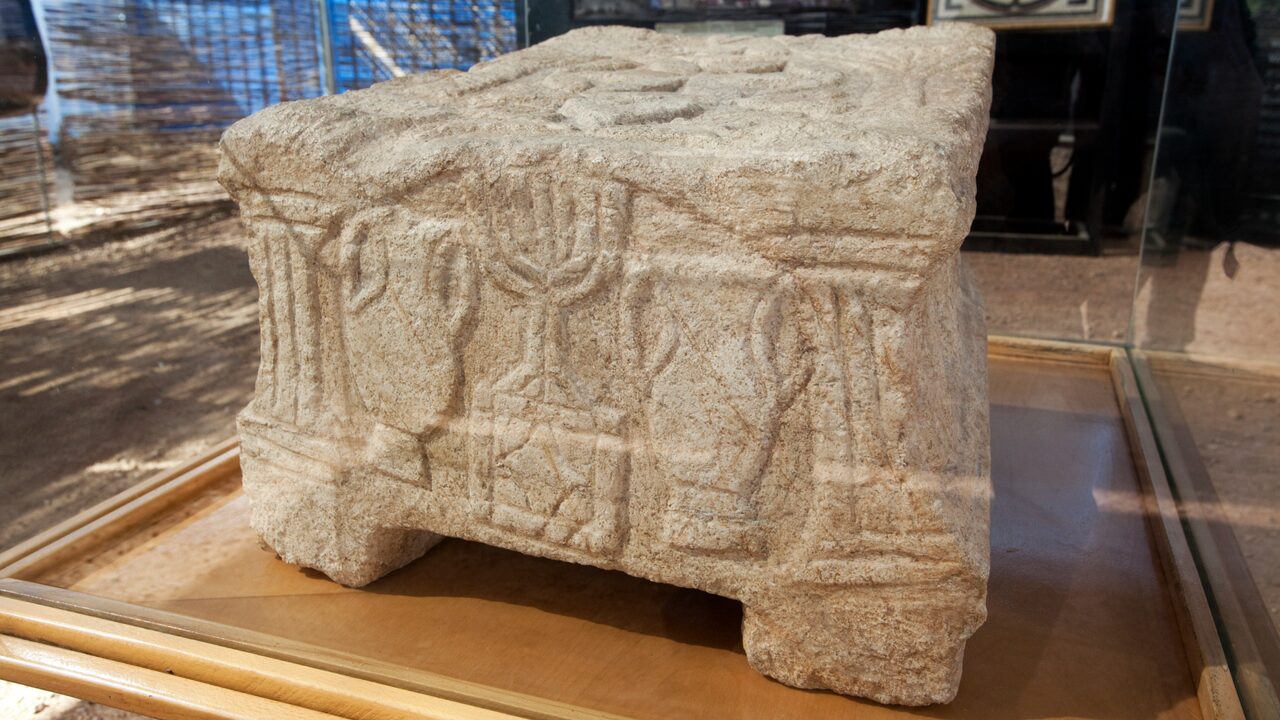
Archaeologists have uncovered the Magdala stone, a remarkable 2,000-year-old carved limestone block featuring the world’s oldest known depiction of a menorah. Discovered in 2009 at the site of an ancient synagogue near the Sea of Galilee, this artifact is believed to predate the destruction of the Second Temple in A.D. 70.
The synagogue, located in the ancient city of Magdala, also referred to as Migdal, is historically significant as the birthplace of Mary Magdalene. The site was active from approximately A.D. 50 until its abandonment around A.D. 80. During an archaeological excavation conducted prior to construction, a unique rectangular block was found within a small room thought to have housed Torah scrolls. This stone, now known as the Magdala stone, measures about 23.6 by 19.7 by 15.7 inches (60 by 50 by 40 centimeters) and is set on four stone feet.
Five sides of the Magdala stone are adorned with intricate carvings, including a prominent seven-branched menorah, which is a significant symbol in Jewish tradition. The menorah depicted on the stone is believed to reflect the design used in rituals at the Second Temple. According to archaeologist Mordechai Aviam, the stone may have served as the base for a Torah reading table, and the decorations likely represent the Holy of Holies shrine, where God’s presence was said to dwell.
Following the sack of Jerusalem in A.D. 70, the Romans famously paraded the gold menorah taken from the Second Temple through Rome, commemorating their military victory on the Arch of Titus. The discovery of the Magdala stone suggests that a pilgrim may have commissioned this representation before the Temple’s destruction, making it the oldest image of the Second Temple’s menorah ever found.
This year, Hanukkah began after sunset on December 14 and lasts for eight days. Today, Jewish people typically light a nine-branched menorah, known as a hanukkiah, to celebrate the rededication of the Second Temple in the second century B.C. after the Maccabees revolted against the Seleucid rulers. The festival commemorates the miracle of the oil that lasted eight days, though scholars debate its significance.
The Magdala stone not only enriches our understanding of Jewish history but also highlights the artistry and religious significance of the era. As archaeological discoveries continue to reveal insights into ancient cultures, the Magdala stone stands as a testament to the enduring legacy of the Second Temple period.