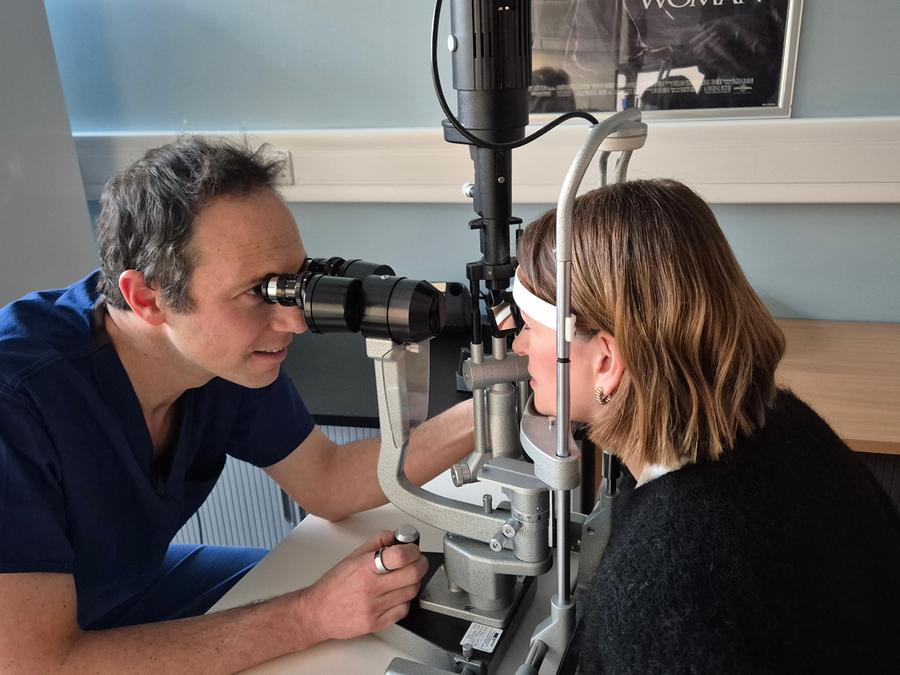
A groundbreaking treatment developed by eye specialist Dr. Harry Petrushkin has restored vision in patients suffering from hypotony, a previously incurable condition characterized by dangerously low eye pressure. The success of this innovative approach has been described by Petrushkin as “beyond [his] wildest dreams.” The consultant ophthalmologist at Moorfields Eye Hospital in London has seen remarkable outcomes, particularly in the case of patient Nicki Guy, who experienced significant vision loss due to this rare disorder.
Hypotony leads to the caving in of the eyeball and can result in blindness if left untreated. Until now, effective treatment options have been limited. However, research conducted at Moorfields indicates that seven out of eight patients treated with this new method have shown promising results.
Petrushkin, who resides in Cricklewood, has frequently encountered hypotony, especially in children, where it often goes unnoticed due to its asymptomatic nature. He has noted a significant number of adult patients arriving with advanced stages of the condition. “We were taught that this was end-stage eye disease, and there was nothing we could do,” he explained in an interview with the JC.
Guy, aged 47, began experiencing vision issues after the birth of her son in 2017. By 2019, she sought help from Petrushkin after multiple unsuccessful treatments, including eye drops prescribed by other ophthalmologists. Following a routine cataract surgery, she unexpectedly lost sight in one eye. “I then spent the next two years trying to prevent the same fate in her other eye,” Petrushkin recounted. Despite aggressive treatment with immunosuppressive drugs, the situation did not improve.
When the time came for cataract surgery on her second eye, the same complications arose. Faced with limited options, Petrushkin decided to innovate. “We could either insert a clear silicone-based oil, which is the standard care, or explore a different approach,” he detailed. This led to the development of a treatment involving the injection of hydroxypropyl methylcellulose (HPMC) gel into Guy’s eye every few weeks over a period of ten months.
Petrushkin emphasized the importance of frequency in administering the treatment. He likened it to inflating a flat tire: “If you only pump it up once, it doesn’t work. You need to do it repeatedly to maintain the shape.” Previous attempts at treatment had the right concept but lacked the consistent application necessary for success.
Guy has described her experience with the treatment as “life-changing,” stating, “It’s given me everything back. I can see my child grow up.” She went from struggling to count fingers to regaining clear vision. According to Petrushkin, this method could potentially benefit between 500 and 1,000 patients annually.
One of the most rewarding aspects of ophthalmology, Petrushkin noted, is receiving feedback from patients whose lives have been transformed. “This case highlights how we often dismiss eyes as beyond hope,” he stated. “My hope is that there is a paradigm shift in how we approach end-stage eye diseases. We must remain open to possibilities where there might be opportunities for recovery.”
The implications of this pioneering treatment could reshape the future of care for patients with hypotony and similar conditions, reinforcing the need for continued exploration and innovation in ophthalmic medicine.