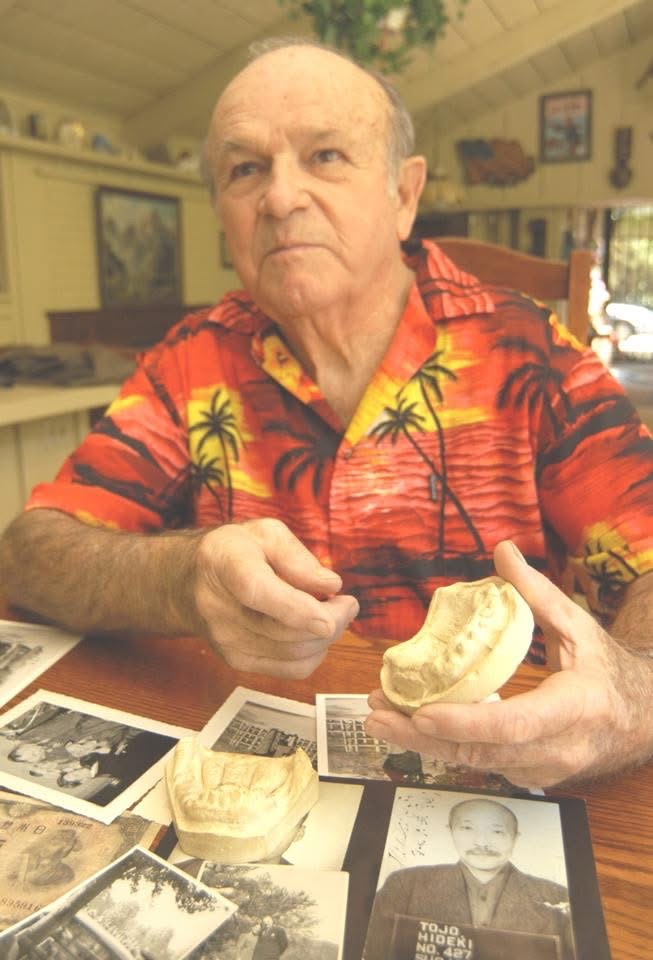
A remarkable anecdote from the aftermath of World War II reveals a unique connection between a US Navy dentist and the infamous Japanese General Hideki Tojo. E.J. “Jack” Mallory, who practiced dentistry in Paradise and Chico, California, crafted dentures for Tojo while he was imprisoned in Tokyo’s Sugamo Prison, awaiting trial for war crimes. This encounter has since become a noteworthy tale, blending humor with historical significance.
From Navy Dentist to War Crimes Trial
In 1946, shortly after earning his dental degree, Mallory received a surprising assignment. Then a 22-year-old Navy dentist, he was tasked with creating a set of dentures for Tojo, who had been suffering from severe dental issues. As the so-called “architect of the war in the Pacific,” Tojo required these dentures to communicate effectively during his impending trial.
“Dad and his colleagues were dedicated and compassionate,” said Paul Mallory, Jack’s son. “Regardless of a person’s background, my father was committed to providing the best care possible.” In his professional journey, Jack Mallory not only demonstrated skill but also a sense of humor that led to a memorable prank during his time with Tojo.
A Prank That Went Global
In 1995, on the 50th anniversary of the attack on Pearl Harbor, Mallory decided to share his story in an article for the Chico Enterprise-Record. This piece sparked a surge of interest, leading to its publication in various magazines and books, including Bill O’Reilly’s “Killing the Rising Sun.” Paul Harvey even recounted the story on his popular radio program, “The Rest of the Story.”
Jack Mallory’s humorous account centers on the dentures he created for Tojo. During his visits to the prison, he found Tojo to be surprisingly amiable, a stark contrast to the image of a fearsome military leader. Tojo, who was facing the consequences of his actions during the war, expressed a resigned attitude regarding his dental care, famously stating, “Oh these will last me six more months and after that, my teeth I won’t be needing anymore.” This comment elicited laughter from those present, including Mallory.
Despite his better judgment, Jack Mallory felt compelled to leave a lasting mark on Tojo’s dentures. He inscribed the words “Remember Pearl Harbor” using Morse code around the inner edge of the dental appliance. While Mallory refrained from adding the phrase directly due to professional ethics, this subtle inscription became a secret that only a few of his colleagues knew.
However, the secret did not stay hidden for long. A rumor about the inscription eventually leaked, causing a flurry of media attention. Mallory, feeling threatened by the potential fallout, sought guidance from his commanding officer, Major William Hill. The situation escalated quickly, leading to a covert operation to remove the inscription before it could be confirmed by the press.
In a snowstorm, Mallory and a colleague made their way to the prison to grind away the evidence of their prank. They worked discreetly, fearing the consequences of their actions. The next day, the story appeared in the Armed Forces newspaper Stars & Stripes, igniting further interest in their escapade.
Reflecting on his experiences, Mallory later visited the war crimes trial, where he spotted Tojo among the defendants. Tojo recognized him, offering a smile that conveyed a moment of understanding, perhaps even gratitude for the humor amidst the gravity of their situation. Mallory’s service in Japan concluded in 1947, but the memory of his encounter with Tojo and the lighthearted prank remained with him.
When Tojo was executed on December 22, 1948, he did so without the dentures made by Mallory. The only mementos remaining were personal items, including the infamous denture that would no longer serve its purpose. The story of E.J. “Jack” Mallory and General Tojo’s dentures serves as a fascinating intersection of history and humor, showcasing the unexpected connections forged during tumultuous times.
In remembrance of this unique story, it is a testament to how humor can emerge even in the darkest of circumstances, leaving a lasting legacy that continues to resonate decades later.