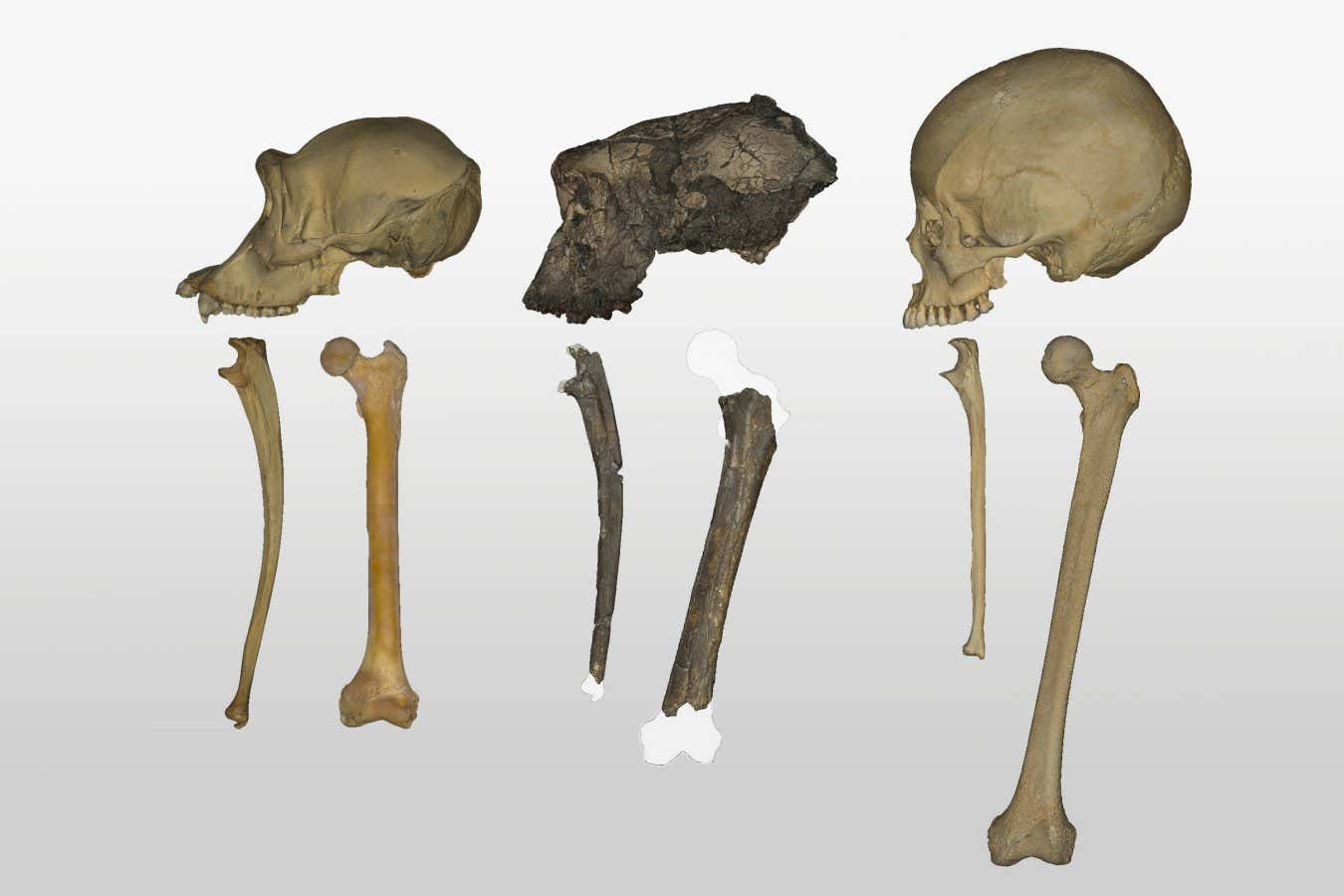
The debate surrounding the locomotion of the earliest known hominin, Sahelanthropus tchadensis, has intensified following new research led by Scott Williams from New York University. His team asserts that a reanalysis of fossil remains suggests this ancient species walked upright rather than exhibiting a knuckle-walking gait similar to that of chimpanzees.
The fossils of Sahelanthropus tchadensis, dating back approximately 7 million years, were first uncovered in Chad in 2002. This discovery included a skull, teeth, and jawbone, which displayed anatomical features distinct from those of great apes. Observations indicated that the skull likely rested atop the spine, a trait associated with upright walking.
In 2004, further findings revealed a femur and an ulna that were also connected to Sahelanthropus. Initially, there was a consensus that these bones indicated a non-bipedal gait. Yet, in 2020, researchers proposed a new interpretation of the femur’s curvature, suggesting a bipedal adaptation. The discourse surrounding this ancient ancestor has been contentious, with arguments emerging from various research teams over the last several years.
In 2022, a team including Franck Guy and Guillaume Daver from the University of Poitiers argued in favor of bipedality, asserting that specific features of the femur supported their claims. Conversely, a 2024 study led by Clément Zanolli from the University of Bordeaux countered that the anatomical traits cited by Guy and Daver could also appear in non-bipedal great apes.
Williams and his colleagues conducted a fresh examination of the femur’s anatomical features, particularly noting the area where the gluteus maximus muscle would have attached. They found that this attachment point resembled those found in hominins, indicating a potential for bipedal movement. Additionally, they analyzed the size and shape of the femur and ulna, noting that while these bones were similar in size to those of chimpanzees, their proportions were more aligned with those of early hominins.
A critical finding was the identification of a feature known as the “femoral tubercle.” Williams explained, “I initially identified it by touch, then confirmed it visually using 3D scans of the fossil. It’s a small bump that sits only where the femoral tubercle would be; the area is smooth in apes and other non-bipeds, but it has a major function.” This feature is significant because it serves as an attachment point for the iliofemoral ligament, crucial for maintaining balance during bipedal locomotion.
Despite the new evidence, Williams expressed caution, acknowledging that the debate surrounding Sahelanthropus is far from resolved. “We’re fairly convinced that Sahelanthropus was an early bipedal hominin at this point, but I’d be foolish to think we ended the debate.”
In response to the latest findings, Guy and Daver reaffirmed their stance on the bipedalism of Sahelanthropus. They stated, “It not only confirms our initial interpretations of the adaptations and locomotion of the earliest hominin Sahelanthropus but also puts forward new arguments supporting its terrestrial habitual bipedalism, despite an overall morphology that remains close to that of a great ape.” They agreed that only the discovery of new remains could conclusively resolve the issue.
John Hawks, an anthropologist at the University of Wisconsin-Madison, voiced his support for Williams’ findings. He noted that these insights point to a complex evolutionary history for the hominin lineage. “It may be misleading to imagine that Sahelanthropus is all hominin or all ape,” Hawks said. “Our evolution started as a fuzzy, gradual set of changes towards more upright posture and movement.”
On the other hand, Zanolli remains unconvinced, arguing that the new study primarily reinforces the similarities between Sahelanthropus and African great apes. He asserted, “In my view, this new study simply confirms that Sahelanthropus long bones resemble those of the African great apes, and that it was probably behaving in ways that could range anywhere in between those of a chimpanzee and a gorilla, but clearly differed from the habitual bipedalism as known in Australopithecus and Homo.”
As research continues, the origins of bipedalism and the evolutionary trajectory of early hominins remain subjects of intense scrutiny and debate. The findings surrounding Sahelanthropus tchadensis not only enhance our understanding of human evolution but also highlight the complexities inherent in interpreting fossil evidence.