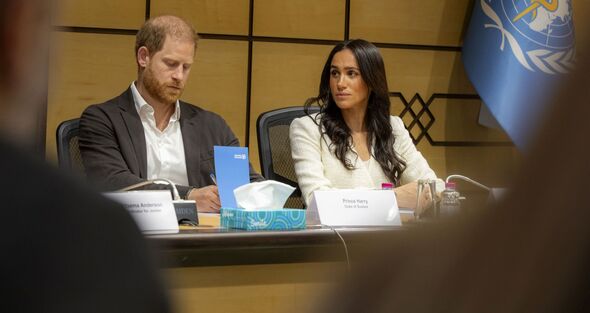
Prince Harry and Meghan Markle undertook a low-profile humanitarian visit to Jordan this week, engaging with children at a refugee camp and participating in various community activities. Their two-day trip included a football shoot-out and a collaboration with the World Health Organization at the National Centre for Rehabilitation of Addicts. Despite the noble undertakings, media coverage of the visit has been notably sparse compared to their earlier tours in Colombia, Nigeria, and Jamaica, which attracted extensive attention.
Public interest in the couple seems to be waning, as indicated by recent opinion polls from YouGov.com. Currently, only 19 percent of respondents view Meghan favorably, marking her lowest rating to date. Prince Harry’s standing is slightly better at 31 percent, while his brother, Prince William, leads the pack with a significant 77 percent favorability rating.
Financially, Harry and Meghan appear stable, with Meghan’s Netflix series and her As Ever product line, which includes wines and jams, generating substantial revenue. Yet, according to PR expert Mayah Riaz, their financial success is closely tied to their popularity. Riaz notes that the couple now operates without the institutional support of the monarchy, making them part of a crowded celebrity landscape.
“Star power alone isn’t sufficient,” Riaz explains. “To remain relevant, they need a clear identity and a compelling reason for audiences to engage.” She emphasizes that while they still possess global recognition, the current climate demands consistency and credibility. The recent scandal surrounding Prince Andrew has not necessarily provided the couple with the opportunity they might have expected. Instead, Riaz suggests that public sentiment often leans towards stability during tumultuous times.
Harry and Meghan previously expressed a desire to focus on charitable work after stepping back from royal duties. However, recent ventures have seen Meghan positioning herself as a lifestyle influencer through her Netflix series, With Love, Meghan, and an upcoming lifestyle brand set to launch in early 2026. This brand will feature a range of products, including raspberry spread, honey, and herbal teas, inviting comparisons to established wellness brands like Gwyneth Paltrow’s Goop, valued at approximately $250 million (£185 million).
Despite these efforts, Riaz points out that Meghan’s current branding may come off as a deviation from their original narrative focused on service and impact. “When they left, the message was about freedom from royal constraints,” she says. “If they pivot towards lifestyle branding, it risks appearing insincere to the public.”
Another contentious topic is privacy. Meghan faced backlash after sharing a Valentine’s Day photo that inadvertently revealed her daughter’s face, contradicting Harry’s calls for greater family privacy. Observers note a growing trend of blurred images of the children appearing on Meghan’s social media, often linked to her brand promotion.
Royal expert Ingrid Seward reflected on this issue, stating, “I would think they have had some pretty fiery rows about the topic, because it’s not at all how Harry wanted it to be.” Critics argue that their actions seem counterintuitive to their initial desire for a private life, suggesting they may be seeking public attention and financial gain.
The couple’s journey has been polarizing. Their attempts to monetize their royal connections while publicly criticizing the monarchy have raised eyebrows. Riaz elaborates, saying, “Initially, sharing their experiences garnered empathy and attention. However, an overemphasis on grievances can become burdensome.” She believes audiences are more inclined to connect with stories of resilience and innovation rather than conflict.
As Harry and Meghan navigate their current trajectory, their recent activities in Jordan may reflect a broader public fatigue with their narrative. “The public has a short attention span, and their story has been explored from numerous angles,” Riaz concludes. “To regain interest, they need to focus on new, forward-looking chapters rather than dwelling on past issues.”
Ultimately, Harry and Meghan find themselves at a critical juncture. They can either fully embrace their roles as global philanthropists with measurable impact or dive headfirst into lifestyle entrepreneurship. Balancing between these two paths could foster confusion, which, in today’s media environment, often leads to indifference.