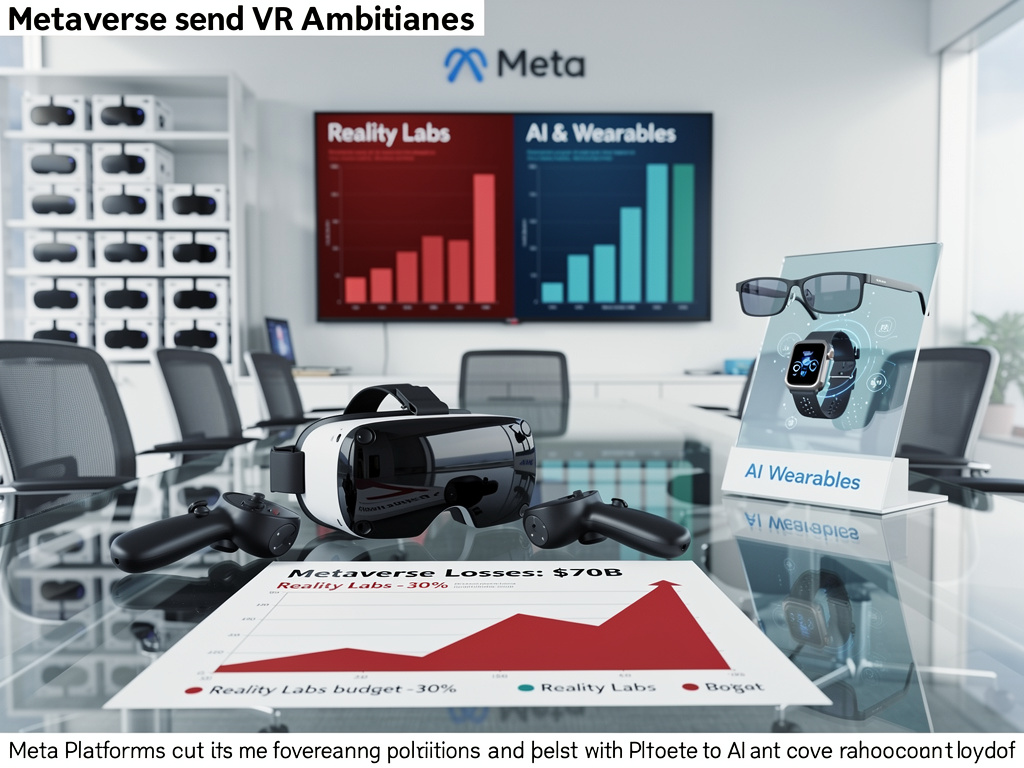
Mark Zuckerberg’s ambitious vision for the metaverse is undergoing a significant transformation as Meta Platforms Inc. announces plans to reduce its Reality Labs budget by up to 30% by 2026. This decision comes in the wake of staggering losses exceeding $70 billion since the company’s 2021 rebranding from Facebook. The cuts indicate a strategic shift away from expansive virtual reality (VR) initiatives towards more practical investments in artificial intelligence (AI) and wearable technology.
As reported by Bloomberg, internal discussions about these budget reductions have intensified, with potential layoffs expected as early as January. The impact will primarily target key metaverse products, including Horizon Worlds and the Quest VR headset line, which have struggled to gain traction despite significant marketing efforts. Instead, Meta plans to redirect resources to AI-driven projects such as Llama models and Ray-Ban smart glasses, reflecting mounting investor pressure for profitability.
Financial Challenges and Strategic Reassessment
Reality Labs, the division responsible for Meta’s metaverse initiatives, reported an operating loss of $4.7 billion in the third quarter of this year. This figure contributes to cumulative deficits that have surpassed $70 billion since 2021, according to Business Insider. Zuckerberg’s 2021 rebranding was a bold declaration of the company’s commitment to virtual and augmented reality as its future. However, lukewarm consumer interest in VR headsets has exposed the risks of this concentrated focus.
Sales of the Quest headset have shown modest growth but have not sparked widespread demand. Furthermore, engagement on Horizon Worlds, Meta’s flagship virtual social platform, has dwindled, with monthly active users remaining below one million. Such shortcomings have attracted scrutiny from investors, leading to a volatile stock price that saw initial dips driven by metaverse enthusiasm before rebounding on the successes of AI initiatives.
Internal Discussions and Market Reactions
Discussions surrounding the budget cuts gained traction following Zuckerberg’s acknowledgment that the metaverse push “is not working” during private meetings. Once committed to investing $10 billion annually in Reality Labs, he is now prioritizing wearables like Orion AR glasses and has been actively recruiting talent from Apple to enhance hardware design.
Meta’s broader efficiency drive has already resulted in layoffs totaling 21,000 jobs since 2022, setting the stage for additional reductions within Reality Labs, which employs over 10,000 people. Sources indicate that budget cuts could save billions, allowing for a reallocation of funds towards AI infrastructure, an area where Meta faces stiff competition from companies like OpenAI and Google.
News of the impending cuts positively affected Meta’s stock, which rose by 3% to approximately $620 on December 4, as reported by CNBC. Analysts view this pivot as a pragmatic move, with some, including those at Bank of America, praising the focus on “higher-return opportunities” in AI and consumer wearables. Nevertheless, this strategic retrenchment raises questions about the long-term hardware strategy for Meta, which plans to de-emphasize standalone metaverse experiences in favor of integrated augmented reality (AR) solutions.
Zuckerberg has positioned AI as the new cornerstone of Meta’s strategy, with significant investments in open-source models like Llama 4 and agentic AI systems. The recalibration within Reality Labs aims to maintain AR eyewear development while scaling back on VR ecosystem investments. An executive emphasized, “We’re not walking away from the metaverse, but we’re being more disciplined,” highlighting the role of wearables as a bridge to future immersive technologies.
Despite these cuts, Meta remains committed to research and development in the metaverse, focusing on lightweight AR devices designed for everyday use. Collaborations with EssilorLuxottica on smart glasses exemplify this evolution, integrating AI assistants with subtle overlays rather than cumbersome VR headsets.
Market projections suggest that losses within Reality Labs may peak in 2025 before declining, contingent on effective cost management. Zuckerberg’s upcoming earnings call will likely provide insight into the strategic adjustments and the division’s future amid Meta’s substantial cash reserves, estimated at $200 billion.