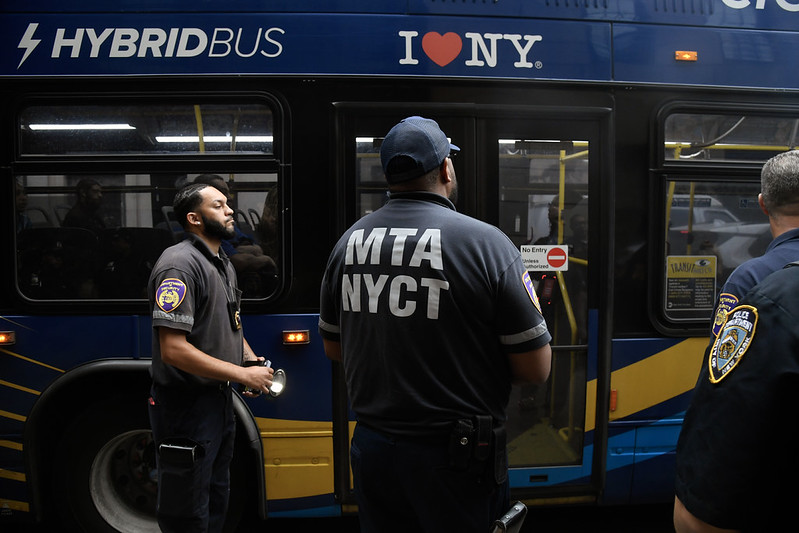
MTA Defends New Phone-Scanning Fare Enforcement System Despite Rider Concerns
The Metropolitan Transportation Authority (MTA) is aggressively expanding a new “European-model” of fare enforcement on New York City buses that scans riders’ phones and credit cards to verify payment, officials confirmed today.
MTA Chair and CEO Janno Lieber defended the system during a news conference after the agency’s April 29 board meeting, emphasizing that most riders have complied so far, though he acknowledged potential pushback from those uneasy about showing digital proof of payment.
“There is a very high rate of customer compliance,” Lieber said, highlighting the use of handheld devices by civilian fare agents from the Evasion And Graffiti Lawlessness Eradication (EAGLE) teams. These agents are tasked with scanning phones, bank cards, or fare cards to confirm fare payment through the contactless OMNY system now fully operational across all buses.
“This is the right way to validate fares in the 21st Century in the Western world,” he added, pointing to similar enforcement models in Europe and beyond.
Fare Evasion Costs MTA Nearly $568 Million in 2026
The move comes as the MTA battles an estimated $568 million in lost revenue from fare evasion on buses this year, according to a report from the Citizens Budget Commission. The agency ended MetroCard sales last year and phased out coins, pushing riders toward OMNY’s contactless payment exclusively.
NYC Transit President Demetrius Crichlow confirmed that EAGLE teams, previously piloted on Select Bus Service routes, are now being deployed on more local buses as well. The agency is training fare agents to handle encounters with riders hesitant to show proof of payment, emphasizing respectful communication and educating the public in advance through leaflets, signage, and onboard information screens.
“We’re having customer information screens changed to be able to tell customers. We’re adding signage to buses so that people know that this change is coming. It is our goal to be as informative as possible,” Crichlow said.
Privacy Assurances as Technology Rolls Out
The MTA reassured riders that the scanning devices do not store personal information beyond verifying a valid fare. This clarification aims to ease privacy concerns amid the new enforcement strategy.
Lieber noted the fare enforcement technology is fundamental to introducing all-door boarding across local bus routes, a move expected to improve boarding speed and overall transit service efficiency. Several buses have had inactive back-door OMNY readers for years, but this enforcement model now allows full activation without fare evasion risks.
What Kentucky and Other US Cities Should Watch
While the new system currently affects New York City buses, the MTA’s approach may influence other transit authorities in the US, including major cities such as Louisville and Lexington in Kentucky, that also grapple with fare evasion and seek innovative solutions.
The rollout signals a broader trend toward high-tech fare enforcement nationwide, with an urgent focus on combating multimillion-dollar revenue losses that impact transit funding and service quality.
Next Steps and Potential Challenges
The MTA continues to monitor public reaction closely. While initial compliance rates are high, officials remain prepared for potential pushback or privacy debates in the coming weeks. Public outreach and rider education will be critical to smooth the transition as the scanning system expands.
For Kentucky residents and other US transit users, the evolving MTA policy serves as an important case study on balancing technological enforcement, rider privacy, and transit agency sustainability.