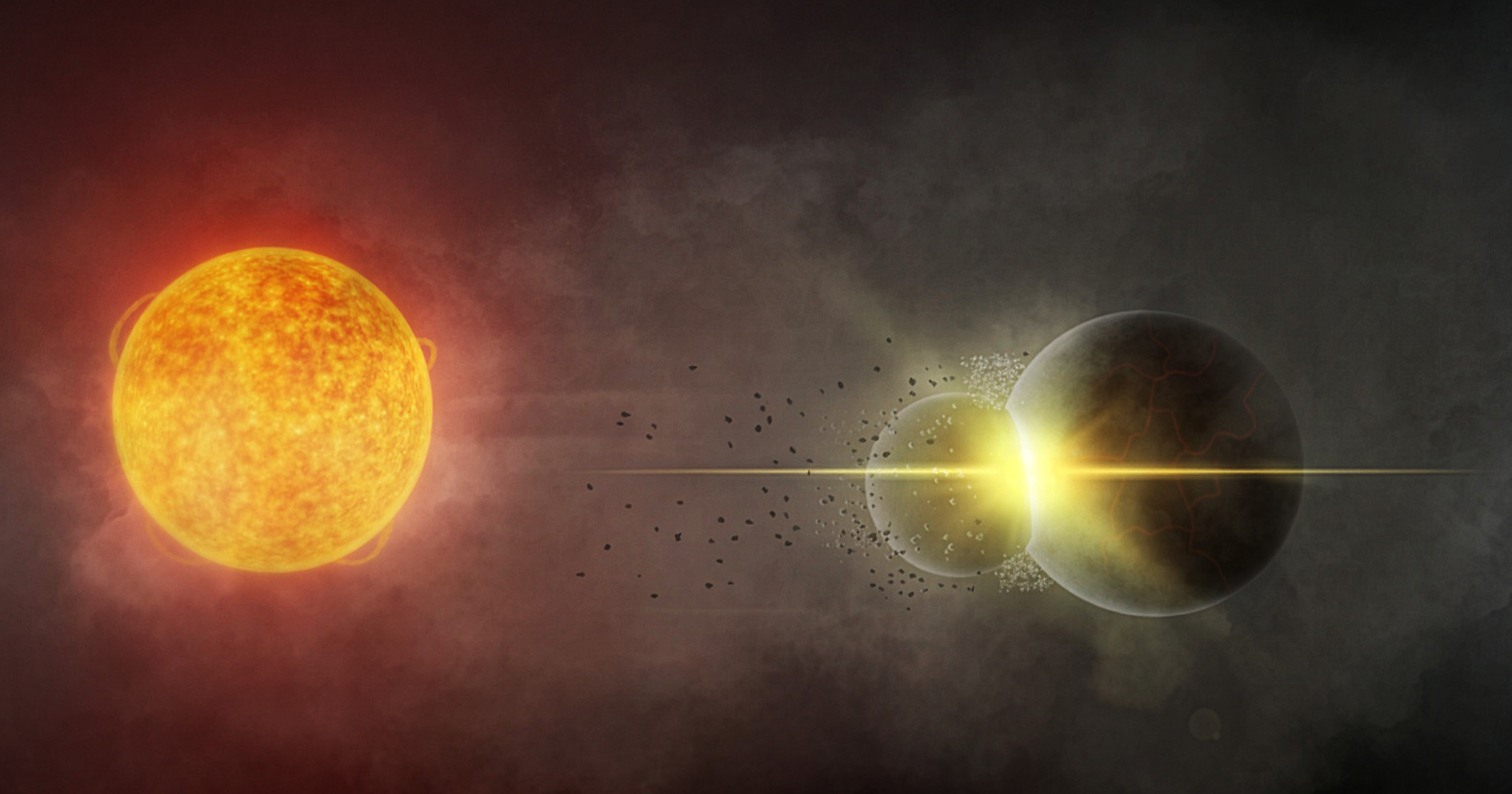
Astronomers have discovered evidence of a catastrophic collision between two distant planets, an event that could enhance our understanding of planetary formation, including the origins of the Moon. A study published in The Astrophysical Journal Letters details the findings related to a star known as Gaia20ehk, which exhibited unusual brightness fluctuations that hinted at this cosmic disaster.
The star, initially appearing stable, began to display erratic behavior around 2016. Lead author Anastasios Tzanidakis, an astronomer at the University of Washington, noted, “The star’s light output was nice and flat, but starting in 2016 it had these three dips in brightness. And then, right around 2021, it went completely bonkers.” This unusual flickering was not merely the sign of a dying star but rather the result of massive debris obstructing its light.
Researchers determined that the fluctuations were caused by significant volumes of dust and rock passing in front of Gaia20ehk. The immense quantity of debris indicated a planetary collision, as the material would need to be considerable to obscure the starlight. Observations from another telescope supported this theory, revealing a spike in infrared light corresponding with the dimming in visible light. This suggests that the debris was exceedingly hot, consistent with the heat produced by a planetary collision.
The two planets involved likely spiraled towards each other, with initial grazing impacts before culminating in a major collision. “At first, they had a series of grazing impacts, which wouldn’t produce a lot of infrared energy. Then, they had their big catastrophic collision, and the infrared really ramped up,” Tzanidakis explained.
This discovery is significant, as it marks one of the few recorded planetary collisions that closely resembles the impact believed to have formed Earth and its Moon. Tzanidakis remarked, “It’s incredible that various telescopes caught this impact in real time.” He emphasized that understanding these types of collisions can provide insights into the formation of planetary systems, including our own.
In a related study conducted in 2023, researchers identified the remnants of a collision between two ice giants in a young star system, forming a hot, torus-shaped debris cloud. However, the current findings have direct parallels to the ancient event that shaped Earth’s history. Approximately 4.5 billion years ago, a hypothetical planet known as Theia is thought to have collided with Earth, resulting in the formation of the Moon from the debris.
The dust cloud observed around Gaia20ehk is located at a distance similar to that of Earth from the Sun, approximately one astronomical unit. This positioning raises the possibility that it could eventually cool and coalesce into a rocky satellite, analogous to our Moon.
Such similarities prompt considerations regarding astrobiology. Tzanidakis noted that the Moon is relatively large in comparison to Earth and plays a crucial role in creating conditions that support life by stabilizing the planet’s axial tilt, influencing tides, and affecting weather patterns. If collisions that lead to the formation of large moons are rare, it suggests that life-sustaining planets may also be uncommon.
“We don’t know how common these dynamics are,” Tzanidakis stated, expressing hope that additional observations of similar collisions will clarify their frequency and implications for planetary systems. As astronomers continue to explore the cosmos, the potential to uncover more about the origins of our solar system remains an exciting prospect.