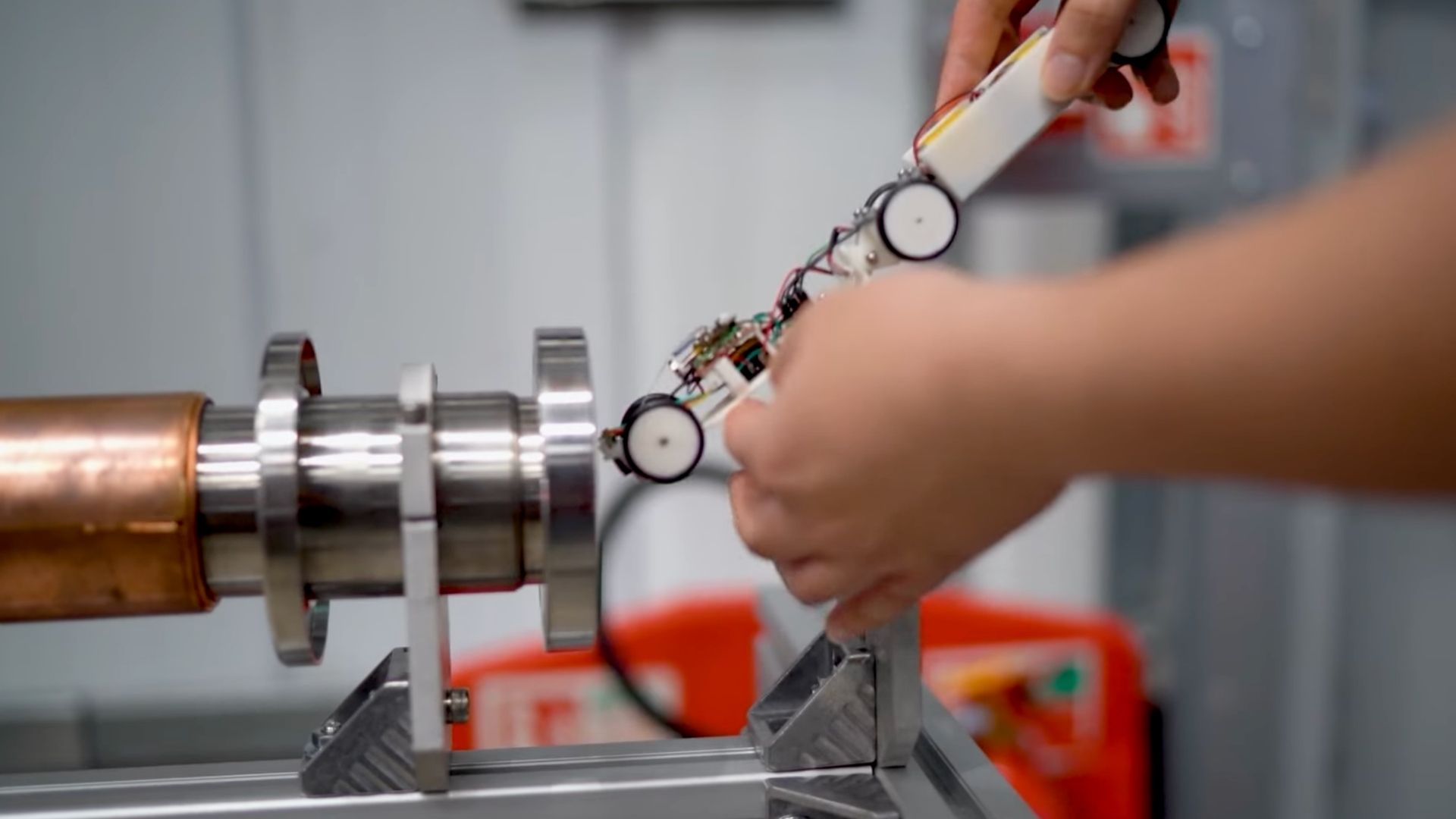
Engineers from the UK Atomic Energy Authority have introduced a groundbreaking robotic device designed to inspect the intricate infrastructure of the Large Hadron Collider (LHC) at CERN. Named PipelNEER, this mouse-shaped robot aims to enhance the efficiency of maintaining the world’s most powerful particle accelerator, which spans an impressive 17 miles (27 kilometers).
The PipelNEER robot utilizes advanced artificial intelligence and sensors to detect faults within the beamline pipes, which are situated deep within the collider’s complex systems. These pipes operate under extreme conditions, with temperatures nearing -455.8 °F (-271 °C) and within ultra-high vacuum environments. Regular maintenance is crucial, but traditionally, inspecting these components requires extensive dismantling, which is both time-consuming and costly.
Addressing Maintenance Challenges
As the PipelNEER navigates through the narrow beamline, it encounters harsh conditions that cause the infrastructure to expand and contract. The LHC contains approximately 2,000 plug-in modules (PIMs), which can suffer from slight bending over time due to thermal cycling. Even minor deformities can compromise the reliability of the collider’s systems, making routine inspections essential for safe operations.
Measuring around 20 centimeters in length, PipelNEER is a pioneering robotic inspector capable of autonomously traversing spaces as narrow as 3.7 centimeters. Unlike traditional inspection tools, it can cover distances of up to 6 kilometers on a single battery charge, making it ideal for long and confined passages. As it moves, the robot captures high-resolution images of each PIM, analyzing them with AI trained on actual imagery from the LHC to identify potential abnormalities.
PipelNEER is equipped with energy-efficient components and multiple safety systems, ensuring reliable performance during extended autonomous missions. Upon detecting a fault, the robot autonomously returns to its starting point, pinpointing the exact location of the issue. This targeted approach significantly reduces the need for extensive dismantling and manual inspection with endoscopes.
Acknowledgments and Future Trials
The collaborative efforts between UKAEA and CERN in developing PipelNEER have been recognized with a ‘Highly Commended’ award at The Engineer’s Collaborate to Innovate (C2I) Awards. Ricky Sykes, Director of RACE at the UK Atomic Energy Authority, expressed pride in applying their robotics expertise from fusion energy to support CERN’s cutting-edge experiments. “By combining our remote handling experience with CERN’s scientific excellence, we’re helping ensure the Large Hadron Collider operates safely and efficiently for years to come,” he stated.
Dr. Giuseppe Bregliozzi, a Beam Vacuum Operation Section Leader at CERN, highlighted the transformative impact of PipelNEER, stating, “It marks a major step forward in keeping our experiments running smoothly.”
Looking ahead, PipelNEER is scheduled for performance trials over a distance of 37 miles (60 kilometers) in 2026. Final production units are expected to be completed by late 2026, with operator training for CERN staff set to commence in early 2027, preparing them for the robot’s deployment.
This innovative robot represents a significant advancement in the maintenance of one of the most complex scientific instruments in existence, promising to improve safety and operational efficiency at CERN.