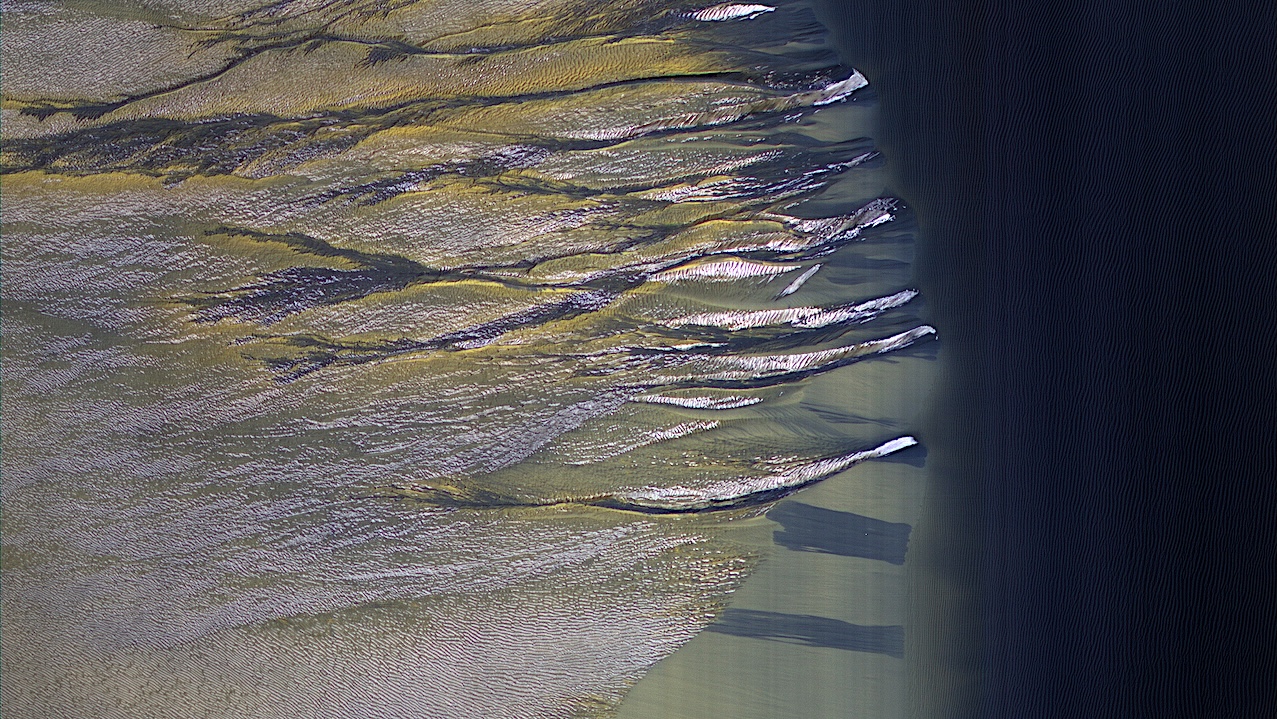
Recent observations of the dunes in the **Kaiser Crater** on **Mars** have unveiled fascinating seasonal changes. A dark sand dune located at the center of the observation is currently covered by a layer of white seasonal ice, typical for winter conditions. However, as the Martian spring progresses, the western slope of this dune is undergoing a notable transformation, with parts of the ice melting away.
In this springtime image, bright patches of frost, which consist of a combination of **water** and **carbon dioxide** ices, stand out prominently against the dark sand. The melting process has led to the formation of dark streaks of sand cascading down the dune’s slope. These flows occur as the frost rapidly transitions from ice to gas due to increasing temperatures from sunlight.
Understanding the Dynamics of Dune Flows
The transformation of frost on the dune is not just a visual spectacle; it also highlights the dynamic nature of Martian geology. As the sun heats the surface, the resulting gas pressure can cause the sand to shift and flow down the slope, sometimes covering the frost beneath. The dark streaks are evidence of this movement, which is influenced by the ripples present on the dune’s surface.
The width of the observed area is approximately **520 meters**, providing a substantial perspective on the scale of these geological features. This phenomenon offers valuable insights into the seasonal processes on Mars and is of particular interest to researchers in **Astrobiology** and **Space Biology**.
As scientists continue to study these changes, they hope to further understand the implications for past water presence on the planet and the potential for future exploration. The defrosting of these dunes not only showcases the beauty of the Martian landscape but also serves as a reminder of the planet’s complex and intriguing environmental dynamics.