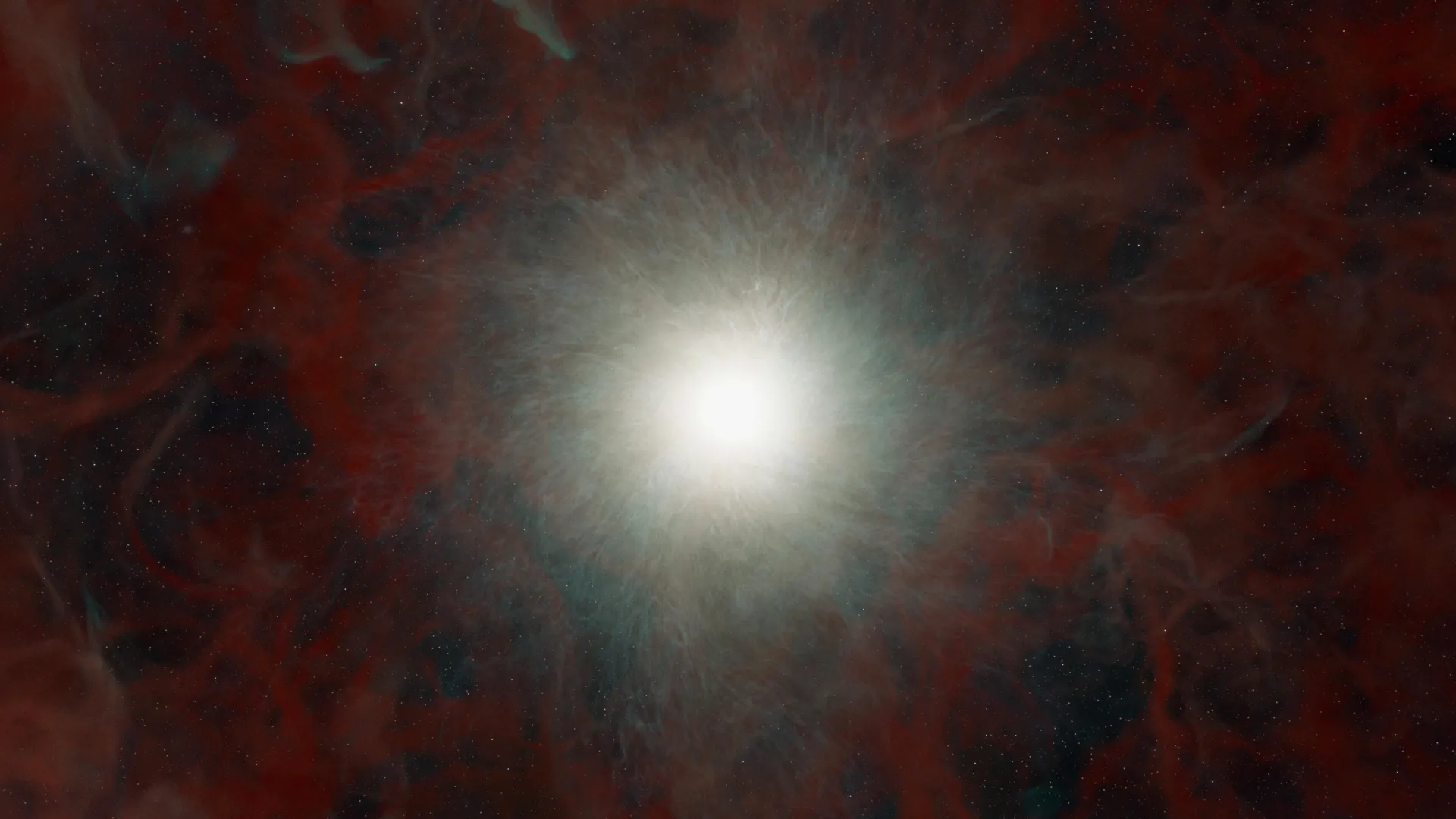
A significant astronomical event has unfolded as astronomers directly observed a massive star, identified as M31-2014-DS1, collapse into a black hole approximately 2.5 million light-years away in the Andromeda Galaxy. Contrary to expectations, this star did not end its life in a spectacular supernova explosion; instead, it underwent a gradual collapse, shedding its outer layers in a slow-motion fade-out. The remnants continue to glow in infrared light, providing a lasting signal of the black hole’s formation.
This groundbreaking discovery, published on February 12, 2026, in the journal Science, marks a pivotal moment in our understanding of stellar evolution. Researchers combined new telescope observations with over a decade of archived data to gain insights into how some of the universe’s largest stars meet their demise. This event stands as the most detailed observation of a massive star transitioning into a black hole, offering a rare glimpse into this process.
Kishalay De, an associate research scientist at the Simons Foundation’s Flatiron Institute and the lead author of the study, emphasized the importance of these findings. “This is just the beginning of the story,” he noted, highlighting the ongoing visibility of the light emitted from the surrounding debris. The James Webb Space Telescope is expected to continue detecting this fading light for decades, potentially serving as a benchmark for future studies of stellar black holes.
The Disappearance of M31-2014-DS1
The observations of M31-2014-DS1 revealed a remarkable brightness in infrared light starting in 2014. By 2016, the star’s brightness dropped dramatically in less than a year, and by 2022 and 2023, it had nearly vanished in visible and near-infrared wavelengths. The star faded to just one ten-thousandth of its original brightness in those bands, leaving only a faint glow in mid-infrared light.
De remarked on the significance of this event, comparing it to the potential disappearance of the well-known star Betelgeuse. “Imagine if Betelgeuse suddenly disappeared. Everybody would lose their minds! The same kind of thing was happening with this star in the Andromeda Galaxy,” he said. The team concluded that such an extreme decline in brightness strongly indicates a core collapse leading to the formation of a black hole.
Understanding the Collapse Mechanism
Stars shine by fusing hydrogen into helium in their cores, creating an outward pressure that counters gravitational forces. For stars with masses at least ten times greater than that of the Sun, this balance falters as nuclear fuel depletes. The core collapses under gravity, typically forming a dense neutron star. In many instances, this collapse generates a shock wave that results in a supernova explosion. However, if this shock wave is insufficient to eject the surrounding material, significant parts of the star may fall back inward, potentially transforming the neutron star into a black hole.
De pointed out, “We’ve known for almost 50 years now that black holes exist, yet we are barely scratching the surface of understanding which stars turn into black holes and how they do it.”
The study also highlighted the role of convection within stars. Large temperature differences create convection currents that circulate gas between hotter and cooler regions. When the core collapses, this motion influences how the outer layers behave. According to models developed at the Flatiron Institute, this convective motion can prevent most outer material from plunging directly into the black hole. Instead, some layers circle the black hole while others are expelled outward.
As the expelled material travels away, it cools and forms dust that blocks light from the hotter gas near the black hole, re-emitting energy in infrared wavelengths. This process results in a lingering reddish glow observable long after the original star has disappeared. Co-author and Flatiron Research Fellow Andrea Antoni explained that the rate of material falling into the black hole is much slower than if the star had imploded directly. This means that the light observed today is a product of this prolonged and complex process.
The research team also revisited a previously identified object, NGC 6946-BH1, which exhibited similar characteristics. The findings suggest that both stars belong to a broader category of failed supernovae producing black holes quietly. Initially considered an “oddball,” M31-2014-DS1 is now recognized as part of a significant pattern in stellar evolution.
As astronomers continue to investigate such phenomena, their discoveries will deepen our understanding of black hole formation and the life cycles of massive stars. These individual cases serve as crucial pieces in the larger puzzle of how the universe evolves, transforming our perspective on the life and death of stars.