UPDATE: On February 5, 2023, installation artist and composer Raven Chacon captivated audiences at UC Davis during a public lecture hosted by the California Studio: Manetti Shrem Artist Residencies. Chacon, who has made significant contributions to the art world, including winning the 2022 Pulitzer Prize for Music and the 2023 MacArthur Fellowship, shared insights into his innovative works that challenge perceptions of sound and identity.
Chacon’s talk delved into his diverse artistic journey, showcasing pivotal pieces that reflect his unique perspective as a Navajo artist from Fort Defiance, Navajo Nation. His early work, “Field Recordings” (1999), emphasizes the power of silence in nature, capturing quiet moments in the Southwest. “The idea was to go to different locations…and make a field recording of that place,” Chacon explained, highlighting the anthropological nature of sound recording.
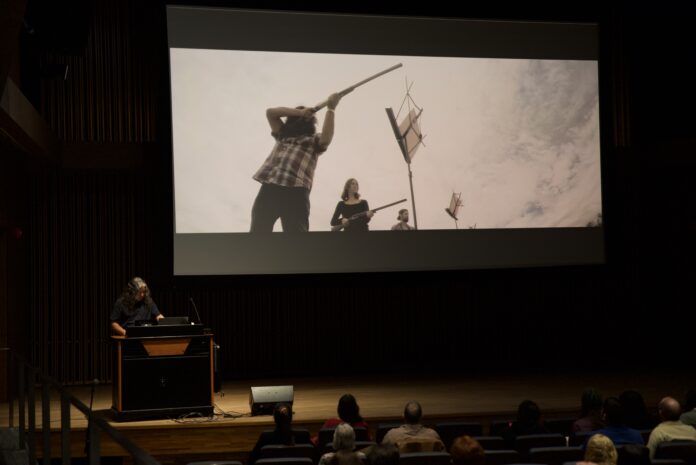
The lecture also featured his provocative composition “Report” (2001), created for guns. “This piece is not explicitly pro- or anti-gun…it reflects on the uniqueness of the weapon and the land,” Chacon stated before presenting a video of the piece. His commentary invites deeper reflection on the relationship between sound and place, making it a compelling topic for discussion.
Chacon, a member of the Indigenous collective Postcommodity, also discussed “Repellent Fence” (2015), a land art installation that critiques border politics. Inspired by a bird repellent balloon, the installation consists of a two-mile-long series of balloons installed near the U.S.-Mexico border. “If a 10-inch balloon could scare away pigeons, then maybe a 10-foot balloon could ward off western civilization,” he said, emphasizing the political implications of his art.
His Pulitzer-winning piece, “Voiceless Mass,” was commissioned by the Present Music ensemble in Milwaukee. Although initially hesitant to compose for a Thanksgiving performance in a Catholic cathedral, Chacon created a powerful piece that symbolizes the loss of Indigenous language and culture. “This piece was never meant to be accusatory…it was meant to bring this history to light,” he noted, fostering dialogue among church leaders about the church’s historical role.
Looking ahead, Chacon’s upcoming large-scale work “Tiguex,” scheduled for 2025, will involve over 200 musicians performing throughout Albuquerque, a city steeped in Indigenous history. He described the project as a musical score for the entire city, blending various musical traditions and cultural expressions.
Following the lecture, UC Davis music students performed Chacon’s “American Ledger No. 1” (2018), a composition that addresses historical conflicts in America. The piece incorporates traditional instruments alongside unconventional sounds, illustrating the complexities of American history.
Chacon’s multifaceted approach to art and music challenges audiences to confront uncomfortable truths and engage in meaningful conversations. As he aptly stated, “Music is the things we don’t know how to speak about,” highlighting the emotional resonance of his work.
This urgent and inspiring talk reaffirms Chacon’s status as a leading voice in contemporary art, making it clear that his work will continue to provoke thought and foster dialogue in the years to come. For those interested in exploring the intersection of sound, culture, and identity, Chacon’s artistic journey is not to be missed.