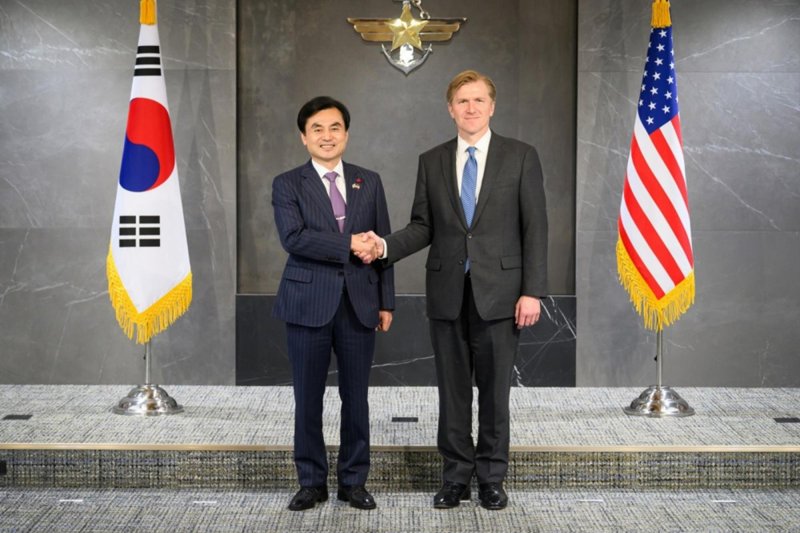
On February 2, 2024, remarks by Undersecretary of Defense for Policy Elbridge Colby at the Sejong Institute in Seoul highlighted key tensions regarding U.S. military presence in South Korea. Colby’s comments underscored the delicate balance between maintaining strong alliances and ensuring perceptions of stability in the face of potential military drawdowns.
The ongoing discussion surrounding the new National Defense Strategy has fueled fears in South Korea about a possible reduction of U.S. forces on the peninsula. These concerns persist despite official reassurances from the U.S. government. The notion of relocating thousands of American troops has circulated for months, creating a narrative of uncertainty that undermines confidence among allies and could embolden adversaries.
Colby’s language, while perhaps unintentional, can act as a pre-authorization for withdrawal. It lays groundwork that can shape expectations and perceptions, crucial elements in alliance politics. If the U.S. alliance appears uncertain, it could embolden North Korea’s leadership, particularly Kim Jong Un, who actively seeks to exploit any signs of division within the ROK/U.S. alliance.
The phrase “critical but more limited support” has emerged as a cornerstone of the new U.S. strategic doctrine. This term appears multiple times in the National Defense Strategy and may contribute to the perception of diminished U.S. commitment. As Kim Jong Un aims to drive U.S. forces from the peninsula, any public discussion that normalizes force reductions can be seen as a victory for the North Korean regime.
In the context of military strategy, the importance of language cannot be overstated. The U.S. must carefully consider how it frames its military commitments. As David Maxwell, executive director of the Korea Regional Review, points out, a simple yet powerful statement could help mitigate risks: “U.S. firepower, on-peninsula, offshore and U.S.-based, will defend the Republic of Korea against any threat.” This clear deterrence language could reinforce commitments and complicate enemy calculations, particularly in the face of uncertainty.
The implications of Colby’s remarks extend beyond military strategy and into the realm of cultural understanding. The term “model ally,” used to describe South Korea, may resonate differently in Seoul than intended. Historically, terms like this have been associated with hierarchical relationships and could be perceived as condescending. In a region where dignity and sovereignty are paramount, such language can have unintended consequences.
While defenders of Colby’s comments may argue that they were meant to acknowledge South Korea’s defense spending and seriousness, intent does not always align with impact. Allies and adversaries alike interpret language through the lens of their historical and cultural context. For South Korea, the notion of being a “model” can feel less like respect and more like conditional approval, undermining the very trust needed for a solid alliance.
As tensions continue to mount in the Asia-Pacific region, particularly with the rise of China, it is crucial that the U.S. approach to its alliances reflects a balance of respect and understanding. The call for increased responsibility from South Korea should be accompanied by increased voice and consultation in defense matters. If South Korea is to be treated as a top-tier partner, it must be included in discussions that acknowledge its sovereignty and contributions.
The media coverage in South Korea following the release of the National Defense Strategy has been notable, with many articles referencing the “model ally” phrase. This repetition shapes public perception and risks normalizing an evaluative framework that could lead to questions about the nature of the U.S. commitment to the alliance.
Ultimately, alliances endure not merely through efficiency but through trust. In Asia, that trust is built on mutual respect and cultural understanding. Misinterpretations can weaken deterrence, particularly when words carry historical weight. As David Maxwell advises, the U.S. must communicate in ways that reflect the seriousness of potential crises. Acknowledging the cultural nuances in language can strengthen alliances and ensure that partners are prepared to stand firm in times of need.