UPDATE: The Supreme Court is set to hear urgent arguments today, October 3, 2023, regarding a controversial Hawaii law that prohibits individuals from carrying firearms onto private property without the owner’s explicit consent. This landmark case, known as Wolford v. Lopez, has significant implications for gun rights across the nation.
Today’s session follows a string of gun rights disputes that have reached the high court since the conservative majority’s pivotal 2022 ruling affirmed the right to bear arms outside the home. The Hawaii law, passed in response to the 2022 Supreme Court decision, aims to limit the presence of firearms in public spaces, particularly retail stores.
The law requires concealed carry permit holders to obtain express permission from property owners before bringing firearms into privately owned spaces that are open to the public. Gun control advocates argue that this measure is essential for maintaining safety in businesses, emphasizing the right of property owners to control what is permitted on their premises.
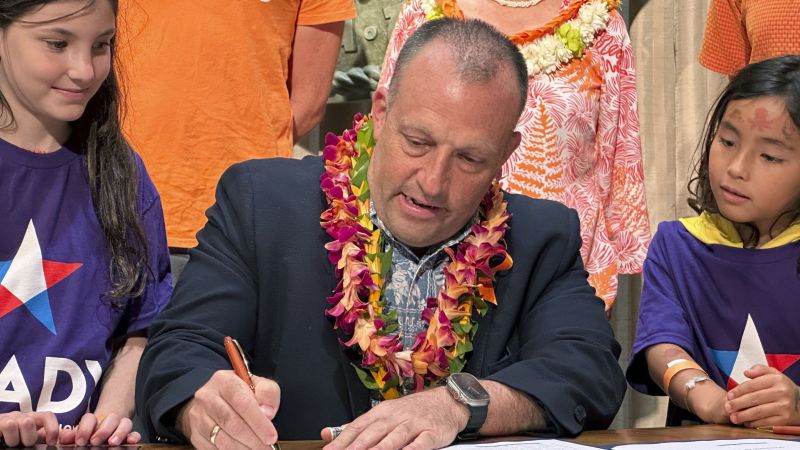
“Since our founding as a nation, private property rights have been foundational to American identity,” stated Douglas Letter, chief legal officer at the gun control group Brady.
Four other states—California, New York, New Jersey, and Maryland—have enacted similar regulations, but opponents claim Hawaii’s law is the most restrictive. A lower trial court initially blocked the statute, but a panel of the U.S. Court of Appeals for the Ninth Circuit upheld it, with the full court declining to rehear the case amid dissent from several members.
Gun rights advocates argue that Hawaii’s law defies the 2022 Bruen ruling, which limited government authority over firearm restrictions. They contend that making it the default rule that firearms are banned in public spaces effectively renders the right to carry nearly impossible. The challengers, including concealed carry permit holders and a local gun rights group, assert that property owners should not have the authority to dictate firearm policies in public venues.
“The right to prohibit firearms belongs to the property owner, not the State,” the challengers argued in court filings.
In response, Hawaii maintains that its law does not infringe upon Second Amendment rights and aligns with the historical precedents set by laws at the time of the Constitution’s framing. Anne Lopez, Hawaii’s Attorney General, noted that similar regulations existed historically, supporting the law’s constitutionality.
As the Supreme Court prepares to hear this pivotal case, all eyes are on the potential outcomes that could reshape gun rights in the United States. The ruling may clarify whether courts should exclusively reference founding-era laws or if they can consider later historical contexts, particularly during the adoption of the 14th Amendment.
This case represents a critical juncture in the ongoing national debate over gun rights and public safety. With the Supreme Court’s decision looming, stakeholders from both sides are bracing for an outcome that could have lasting repercussions on firearm regulations and individual rights across the country.
Stay tuned as this developing story unfolds, and prepare for potential nationwide implications depending on today’s ruling.