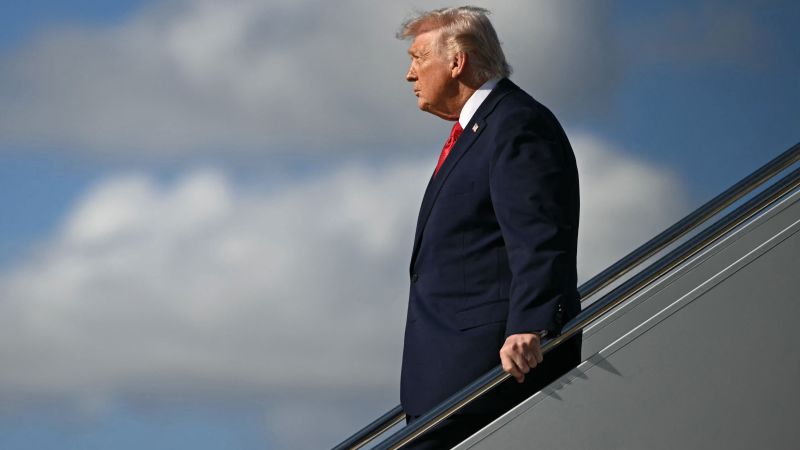
Tensions are rising as Donald Trump continues to assert his controversial claim over Greenland, a semiautonomous territory of Denmark. This situation poses a significant challenge for Europe, particularly for NATO allies who traditionally engage in diplomatic negotiations. Trump’s unconventional negotiating style, characterized by aggression and disregard for established protocols, forces European leaders to reconsider their responses to his demands.
European officials express deep concern over Trump’s insistence that the United States should acquire Greenland, labeling it a dangerous precedent that undermines international law. Rasmus Jarlov, a member of the Danish parliament, voiced his apprehension, stating, “We can never give in to a demand that we should just hand over land and people that the United States has absolutely no right to.” The growing alarm among European leaders reflects a broader unease about the stability of international alliances under Trump’s leadership.
The escalating rhetoric surrounding Greenland has prompted discussions among European nations about potential retaliatory measures. Some lawmakers suggest a trade war, while others contemplate targeting US technology industries. There are even discussions about boycotting the upcoming FIFA World Cup, which is partially hosted by the United States. Such drastic measures illustrate the seriousness of the situation and the lengths to which Europe may go to assert its sovereignty.
Trump’s approach to negotiations is often described as “no compromise,” where he appears willing to jeopardize longstanding alliances for the sake of securing what he wants. This was evident during the recent government shutdown, where the president showed little concern for the ramifications on federal workers and low-income Americans. For NATO’s European members, the risk of a breakdown in the alliance could be a price Trump is willing to pay if it serves his interests.
The challenges in reasoning with Trump are compounded by his unique worldview. He has perpetuated the idea that Greenland could be vulnerable to threats from Russia or China, despite the fact that it is NATO territory. Under existing treaties, the United States has access to deploy forces on the island, making Trump’s claims perplexing to European leaders.
Recent statements from Trump indicate a personal stake in Greenland, with the president suggesting that ownership of the territory is “psychologically important” for him. His comments have raised eyebrows, particularly when he implied that acquiring Greenland could serve as a consolation for his failure to secure a Nobel Peace Prize.
European leaders have attempted to appeal to Trump’s sense of history and international norms, but such efforts appear futile. Danish Foreign Minister Lars Løkke Rasmussen emphasized the importance of international law, stating, “You can’t cross this line.” Yet, Trump’s track record suggests he is unresponsive to such appeals.
As the situation develops, Europe faces a crucial decision: should it adopt a more assertive stance in response to Trump’s demands? Some leaders propose that Europe could find strength in unity, particularly given its significant economic ties with the United States. A trade deal that Trump touted as a success could be jeopardized if he continues to push for Greenland.
In light of these developments, French President Emmanuel Macron has reportedly urged the European Union to activate measures that could restrict US access to EU markets. Such actions could have widespread implications, potentially leading to higher prices for consumers and affecting millions of jobs in the United States.
The prospect of a full-blown trade war looms large, with both sides set to suffer considerable economic consequences. In an editorial, Le Monde warned, “Inevitably, if Donald Trump persists, a showdown is necessary.” European leaders now grapple with the challenge of not only defending their interests but also navigating the unpredictable landscape of Trump’s foreign policy.
As discussions unfold, there remains hope among some that Trump’s aggressive stance is merely a negotiating tactic. British Prime Minister Keir Starmer has advocated for calm discussions between allies while firmly rejecting Trump’s threats. The delicate balance between confrontation and diplomacy will be critical as Europe seeks to respond to a leader whose unorthodox methods have shaken the foundations of international relations.
In this era of heightened tensions, the question of how Europe will respond to Trump’s demands for Greenland remains unanswered, underscoring the complexities of maintaining alliances in a rapidly changing political landscape.