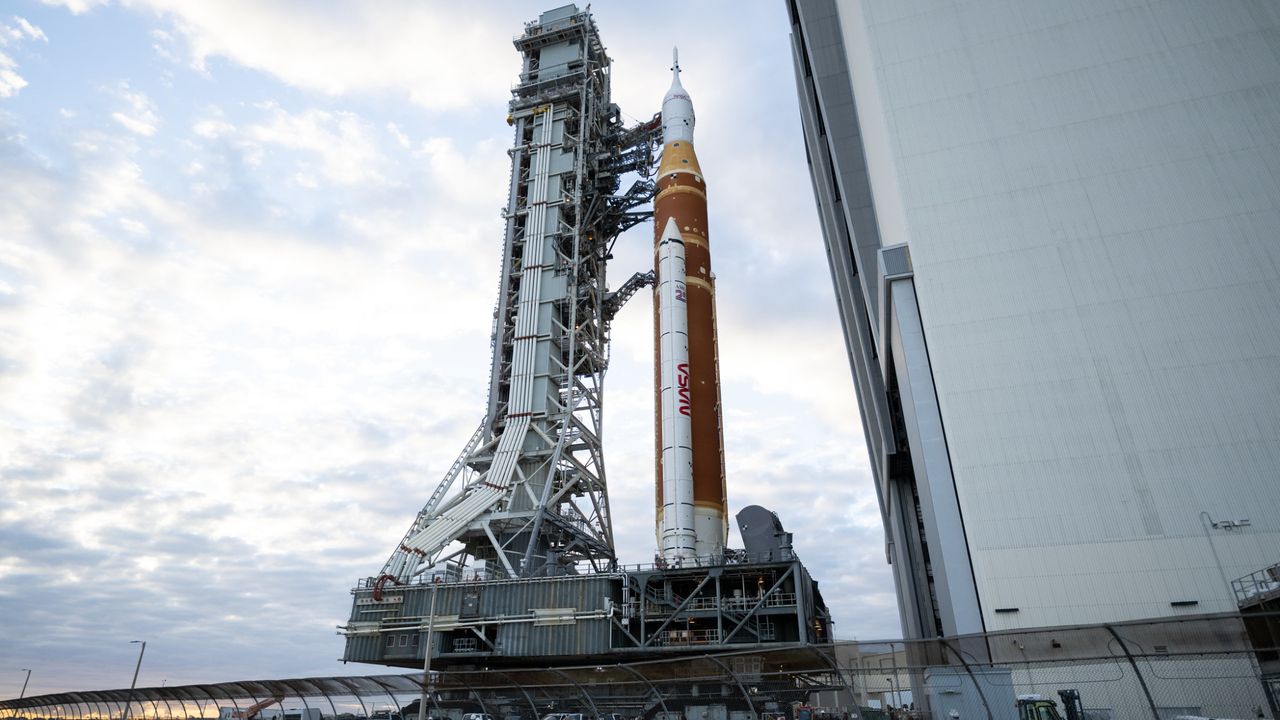
NASA’s Space Launch System (SLS) rocket has begun its journey to the launch pad in preparation for the Artemis 2 mission, which aims to send humans back to the Moon for the first time in over 50 years. The rocket departed the Vehicle Assembly Building (VAB) at Kennedy Space Center (KSC) in Cape Canaveral, Florida, on January 17, 2024, for a significant moment in space exploration history.
The SLS, designed specifically for deep space missions, will support NASA’s Artemis 2 mission, marking a new era of crewed lunar flights. This morning, the rocket began its 4-mile (6.4 kilometers) trek to Launch Complex-39B (LC-39B) at 07:04 a.m. EST (12:04 GMT). Standing at an impressive 322 feet (98 meters) tall and weighing approximately 2,870 tons (2,600 metric tons) when fully fueled, the SLS is a formidable launch vehicle.
Engineers have worked diligently for the past year and a half to assemble the Artemis 2 SLS. Today marked its first rollout as a fully integrated launch vehicle. The SLS is equipped with two solid rocket boosters, each standing 177 feet (54 meters) tall, and four RS-25 engines, originally developed for the space shuttle. Together, these components generate a powerful thrust of 8.8 million pounds at liftoff, propelling the rocket and the Orion crew capsule into space.
As the rocket made its slow journey—moving at less than 1 mph (1.6 kph)—its arrival at LC-39B is expected to take between eight to ten hours. Once at the launch pad, NASA will conduct a series of system integrations and vehicle checks leading up to a crucial test known as a wet dress rehearsal. This rehearsal is scheduled for February 2, 2024, with a potential launch window opening on February 6.
The Artemis 2 mission will carry NASA astronauts Reid Wiseman, Victor Glover, Christina Koch, and Canadian Space Agency astronaut Jeremy Hansen aboard the Orion spacecraft for approximately ten days. The flight will not enter lunar orbit but will utilize a “free-return trajectory,” allowing the spacecraft to loop around the Moon and return safely to Earth, regardless of any issues that may arise during the mission.
This mission follows the uncrewed Artemis 1, which successfully launched in November 2022. NASA officials are optimistic about Artemis 2, hoping to avoid the complications that plagued the previous mission, which included multiple delays due to technical issues and weather conditions. The agency has established backup launch opportunities through February 11, with additional windows available in March and April.
Artemis 2 is a crucial step towards NASA’s ambition of returning astronauts to the lunar surface. Future missions, including Artemis 3, aim to land astronauts on the Moon, particularly in the south polar region, as part of a broader strategy to establish a sustainable human presence on the Moon before venturing to Mars.
The crew members have been actively training at KSC, participating in launch day rehearsals to prepare for the mission. Their presence at the SLS rollout today underscores the significance of this milestone in human space exploration.
As the countdown to Artemis 2 continues, the world watches with anticipation the next chapter in lunar exploration.