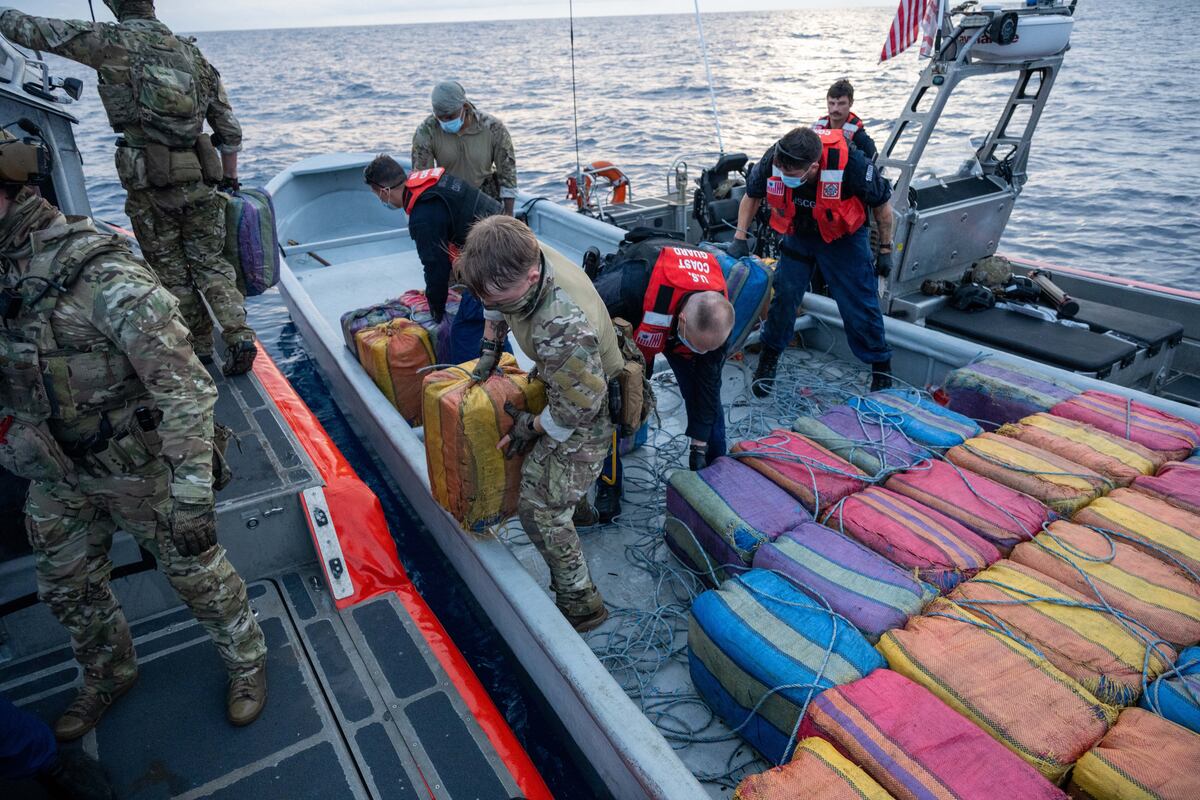
The U.S. Coast Guard has struggled to meet its drug interdiction targets for the past decade, largely due to a significant shift in focus towards migrant interdiction at sea. According to a report released by the Government Accountability Office (GAO) on March 12, 2024, this redirection of resources has contributed to the Coast Guard’s failure to achieve its drug interdiction goals from 2015 to 2024.
The GAO’s findings reveal that the Coast Guard missed its drug interdiction metrics during this period, while also falling short on migrant interdiction goals for six of those years. This shift in focus was influenced by limited resources, including a reduction in available vessels and aircraft, delays in acquiring replacements, and workforce shortages. The report highlights that the Coast Guard’s performance measures did not accurately reflect the effectiveness of its drug and migrant interdiction efforts.
In response to these findings, Coast Guard officials announced the development of six new drug interdiction performance measures, which are already in use as of July 2025. However, the service is still in the process of establishing new performance measures for migrant interdiction.
To make its drug interdiction targets more achievable, the Coast Guard lowered its goals three times over the past ten years. Despite these adjustments, the organization still failed to meet its targets, demonstrating the ongoing challenges it faces.
Operational Challenges and Resource Allocation
Several issues have hindered the Coast Guard’s drug interdiction capabilities. The agency’s reliance on medium endurance cutters has become problematic, with operational availability declining from fiscal year 2020 to 2024 due to equipment failures. Additionally, the lengthy acquisition process for new vessels and aircraft, coupled with budget constraints, has exacerbated the situation.
Staffing shortages have also played a critical role. Although the Coast Guard met its recruiting goals in fiscal year 2024, from 2019 to 2023, it fell short of its objectives, leaving a deficit of 2,600 service members by the end of 2024. The redirection of resources in response to a surge in maritime migration since 2022 further compounded these challenges.
The Coast Guard experienced its highest levels of maritime migration in 30 years from fiscal years 2022 to 2024, with nearly 70,000 migrants attempting to reach the U.S. through the Caribbean Sea and Florida Straits. Data indicates that maritime migration averaged 8,200 migrants from 2015 to 2021, but surged to 34,000 migrants in 2022 and 2023.
From August 2022 to September 2024, the Coast Guard deployed 80 cutters in support of Operation Vigilant Sentry, which focuses on both drug and migrant interdiction in the Caribbean. Of these, 38 cutters were reassigned from other missions. Coast Guard officials have classified migrant interdiction as a “life-saving mission” and a “higher-priority mission,” which reflects their commitment to addressing the humanitarian aspects of migration.
During the same period, the Coast Guard increased operational hours for aircraft and vessels dedicated to migrant interdiction by 66%, while drug interdiction efforts saw a 62% reduction in operational hours. This shift resulted in a significant decline in drug seizures, with the number halving from 218 seizures in 2021 to 112 seizures in 2023.
Future Directions and Recommendations
The GAO report indicates that drug interdiction performance has been hindered not only by resource allocation but also by an increased demand for search-and-rescue missions and adaptive strategies by criminal organizations. The Coast Guard acknowledged that these organizations have become more adept at evading capture.
Despite prioritizing migrant interdiction, the agency only met its performance targets for migrant efforts in fiscal years 2016, 2017, 2022, and 2023. To address these challenges, the GAO has recommended that the commandant of the Coast Guard develop new performance measures for migrant interdiction efforts. Furthermore, the Secretary of Homeland Security is urged to ensure that the Operation Vigilant Sentry task force implements effective methods for sharing lessons learned across federal agencies.
As the Coast Guard continues to navigate the complexities of drug and migrant interdiction, the need for a balanced approach that addresses both challenges remains critical. The outcomes of these efforts will not only impact operational effectiveness but also the safety and security of those navigating the waters of the Caribbean and beyond.