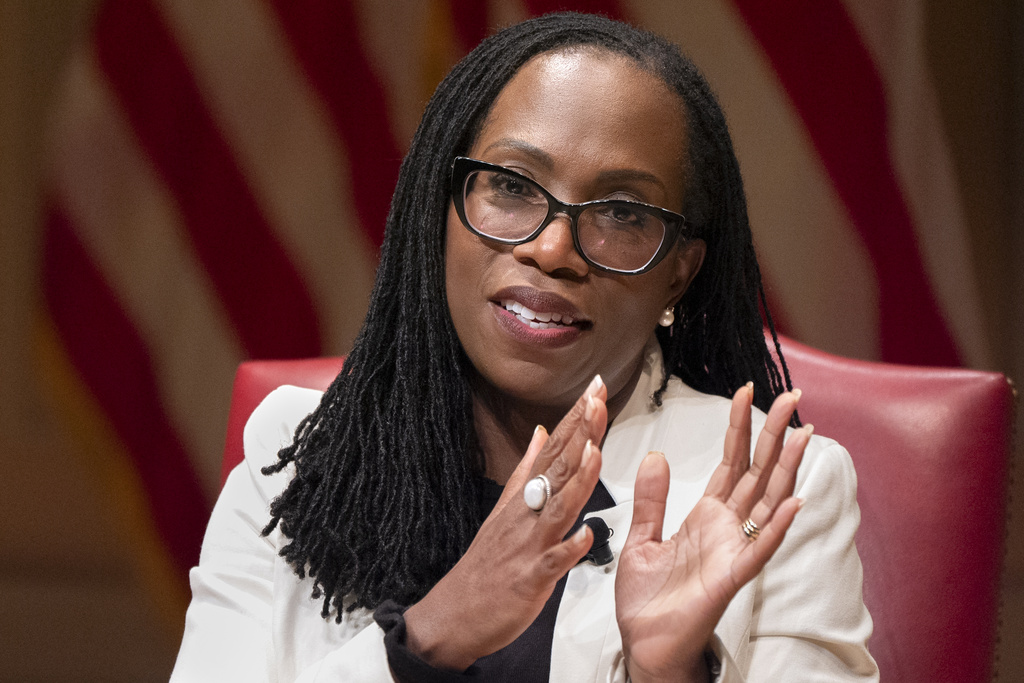
Justice Ketanji Brown Jackson has raised serious concerns regarding a recent ruling by the United States Supreme Court. The decision permits Congressman Michael Bost, a Republican from Illinois, to proceed with a lawsuit challenging the legality of counting mail-in ballots received after Election Day. This ruling has drawn significant attention due to its potential implications for future elections.
In a dissent released on March 15, 2024, Jackson warned that the ruling could lead to an increase in politically motivated legal challenges. She criticized the majority’s decision for removing the usual standing requirements, which she believes could encourage more election-related litigation. “Alarmingly, today’s ruling also has far-reaching implications beyond Bost’s election,” Jackson stated, emphasizing the potential for destabilizing electoral processes. Her dissent was supported by Justice Sonia Sotomayor.
The majority opinion, authored by Chief Justice John Roberts, argued that candidates possess a legitimate interest in the rules governing vote counting, even if these rules might negatively impact their electoral prospects. Roberts wrote, “Candidates have a concrete and particularized interest in the rules that govern the counting of votes in their elections.” He added that alternative approaches to determining standing could lead to a surge of disputes occurring shortly before or even after elections.
Bost’s case had initially been dismissed by a district court, with the Court of Appeals for the 7th Circuit upholding this dismissal on the grounds of lack of standing. The Supreme Court’s ruling reversed this decision, allowing the lawsuit to progress. The majority opinion emphasized that candidates have an interest in both the integrity of elections and the democratic process, suggesting that without this ruling, many disputes would remain unresolved until after elections.
Jackson contested the majority’s reasoning, arguing that candidates should not be allowed to challenge election rules without demonstrating personal harm. She voiced her concern that the ruling opens the door for candidates to file lawsuits that lack a solid basis in established legal precedents. The dissenting opinion pointed out that this could lead to confusion and instability within the electoral system.
Justice Amy Coney Barrett, who was appointed by President Donald Trump, wrote a concurring opinion, agreeing with the majority’s conclusion that Bost has standing, but questioning the reasoning behind it. Barrett contended that Bost’s standing should be based on a traditional pocketbook injury rather than his status as a candidate. She further stated, “I cannot join the Court’s creation of a bespoke standing rule for candidates,” emphasizing that standards for litigants should remain consistent across the board.
In her dissent, Jackson acknowledged Barrett’s rejection of the candidate-standing rule, but argued that Barrett’s justification was also insufficient to establish standing for Bost. Jackson’s critique highlights the ongoing debate within the Court regarding the balance between electoral integrity and access to the judicial system.
As the case returns to a lower court for further proceedings, the implications of this ruling are expected to be felt in upcoming elections. Legal experts and political analysts will be closely monitoring how this decision influences election-related litigation in the future, as well as its impact on the overall electoral landscape in the United States.