Researchers at the University of Konstanz have introduced a novel, contact-free method for removing liquids from delicate microstructures, a breakthrough that could enhance the manufacturing process of microchips and other advanced technologies. This innovative approach utilizes vapor condensation to create surface currents that effectively transport droplets away from sensitive surfaces, ensuring no damage occurs during the cleaning process.
The study, led by physicist Stefan Karpitschka, was published on January 13, 2026, in the journal Proceedings of the National Academy of Sciences. It addresses a significant challenge faced in the production of microchips, which often involves exposure to various liquids that must be thoroughly removed afterward to maintain the integrity of the microscopic elements.
Understanding Surface Tension and Its Applications
Surface tension is a key factor in this new method. Every liquid has a unique surface tension, influencing how it interacts with other materials. For instance, water’s surface tension allows small insects like the water strider to walk on it, while also shaping soap bubbles. However, when it comes to micro- and nanoscopic structures, even minimal surface tension can lead to damage.
Manufacturing microchips involves intricate steps, many of which require wet processing. Karpitschka explained that processes like etching transistors in acid baths necessitate careful drying afterward. Traditional methods, such as wiping the surfaces or boiling off remaining liquids, are ineffective and can leave contaminants behind.
To overcome these challenges, Karpitschka and his team developed a method that employs the Marangoni force. This principle takes advantage of variations in surface tension across a surface, creating a current that can transport liquids effectively. The researchers introduce additional liquid—such as alcohol vapor, which has a lower surface tension than water—to facilitate this movement.
Innovative Techniques for Liquid Management
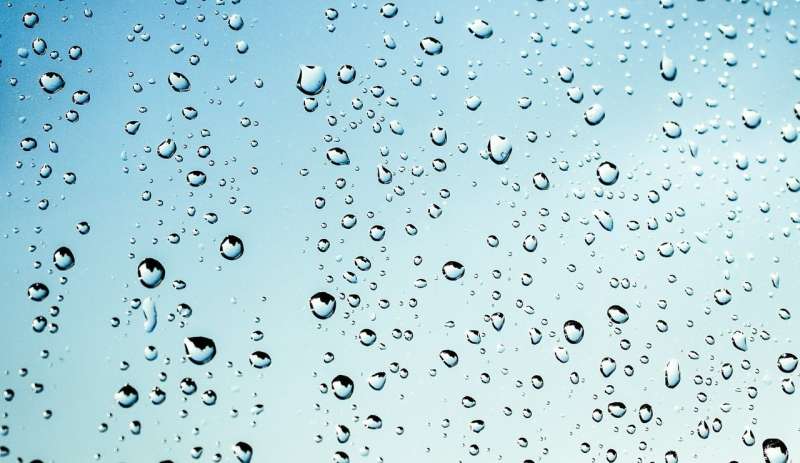
In their experimental setup, the researchers evaporate alcohol, which condenses on the existing liquid. This creates a differential in surface tension, allowing the generated currents to pull the liquid away in a controlled manner. Karpitschka likened the process to raindrops coalescing on a windowpane, as the droplets are directed to form larger drops that can be easily removed.
The implications of this research are vast and extend beyond microchip manufacturing. The method can be applied in various fields involving micropatterned surfaces, promoting efficient drying of small structures without compromising their integrity. This could pave the way for advancements in the production of micro- and nanomaterials, enhancing both efficiency and quality.
The work of Karpitschka and his colleagues reflects a significant step forward in fluid management technologies, blending physics with practical applications in modern manufacturing. As industries continue to evolve, innovations like these underscore the importance of developing gentle yet effective solutions for handling delicate materials.
For further reading, the study titled “Vapor-mediated wetting and imbibition control on micropatterned surfaces” is available in the Proceedings of the National Academy of Sciences and authored by Ze Xu and others.