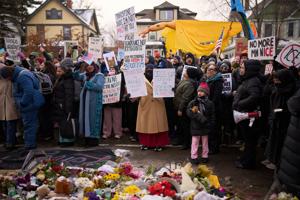
Federal agents executed immigration arrests in Minneapolis on Sunday, intensifying tensions in a city still reeling from the recent fatal shooting of Renee Good. This operation, described by the Department of Homeland Security as its largest enforcement action to date, involved agents forcibly entering a home in the Twin Cities, where they apprehended a man shortly after using pepper spray on protesters outside.
The incident unfolded in a neighborhood filled with single-family homes, where demonstrators attempted to disrupt the operation by honking car horns, banging drums, and blowing whistles. Video footage captured the chaotic scene as agents clashed with protesters, who were voicing their opposition to the aggressive tactics. A woman later exited the home holding a document presented by the federal agents, which was signed by an immigration officer. Notably, this document does not equate to a warrant issued by a judge, which would legally permit forced entry into a residence.
Tricia McLaughlin, a spokesperson for Homeland Security, reported that over 2,000 immigration arrests have taken place in Minnesota since the operation began in early December. This heightened enforcement activity has left many residents on edge, particularly following the shooting of Good, a 37-year-old woman killed by an immigration officer on Wednesday.
Local officials are voicing their concerns. Jason Chavez, a Minneapolis city council member, expressed that federal agents have been increasingly visible in the community. “We’re seeing a lot of immigration enforcement across Minneapolis and across the state,” he noted. Chavez, whose family immigrated from Mexico, is monitoring communications about federal agent activity in areas with growing immigrant populations.
In response to the ongoing enforcement operations, community members have mobilized to act as observers. According to Luis Argueta, a spokesperson for the local human rights organization Unidos MN, more than 20,000 residents have participated in training sessions to learn about their rights during such encounters. “It’s a role that people choose to take on voluntarily, because they choose to look out for their neighbors,” Argueta said.
The protests have largely remained peaceful, but anxiety persists among residents. In light of the recent violence, Minneapolis Public Schools announced that they would shift to remote learning for the next month to safeguard students amid heightened tensions. Several schools had already closed in the aftermath of Good’s shooting.
As the enforcement operations continue, two prominent Minnesota Democrats have called for a more comprehensive investigation into Good’s death. Minneapolis Mayor Jacob Frey and U.S. Senator Tina Smith emphasized the need for state authorities to be involved. Smith expressed skepticism regarding the federal government’s ability to conduct an unbiased investigation, stating, “How can we trust the federal government to do an objective, unbiased investigation, without prejudice, when at the beginning of that investigation they have already announced exactly what they saw?”
The Trump administration has defended the officer involved in Good’s shooting, asserting that he acted in self-defense. Todd Lyons, acting director of Immigration and Customs Enforcement (ICE), reiterated this stance during an appearance on Fox News, claiming that the officer had mere moments to respond to a perceived threat.
The shooting of Good, alongside other incidents involving federal agents, has sparked widespread protests across the country. Thousands participated in demonstrations in Minneapolis over the weekend, while the deployment of immigration officers in the Twin Cities has been characterized as the largest immigration enforcement operation to date by Homeland Security.
As tensions persist, the community remains vigilant, with many residents advocating for their rights and the protection of their neighborhoods. The ongoing situation reflects broader national conversations about immigration enforcement, community safety, and the role of federal authorities.