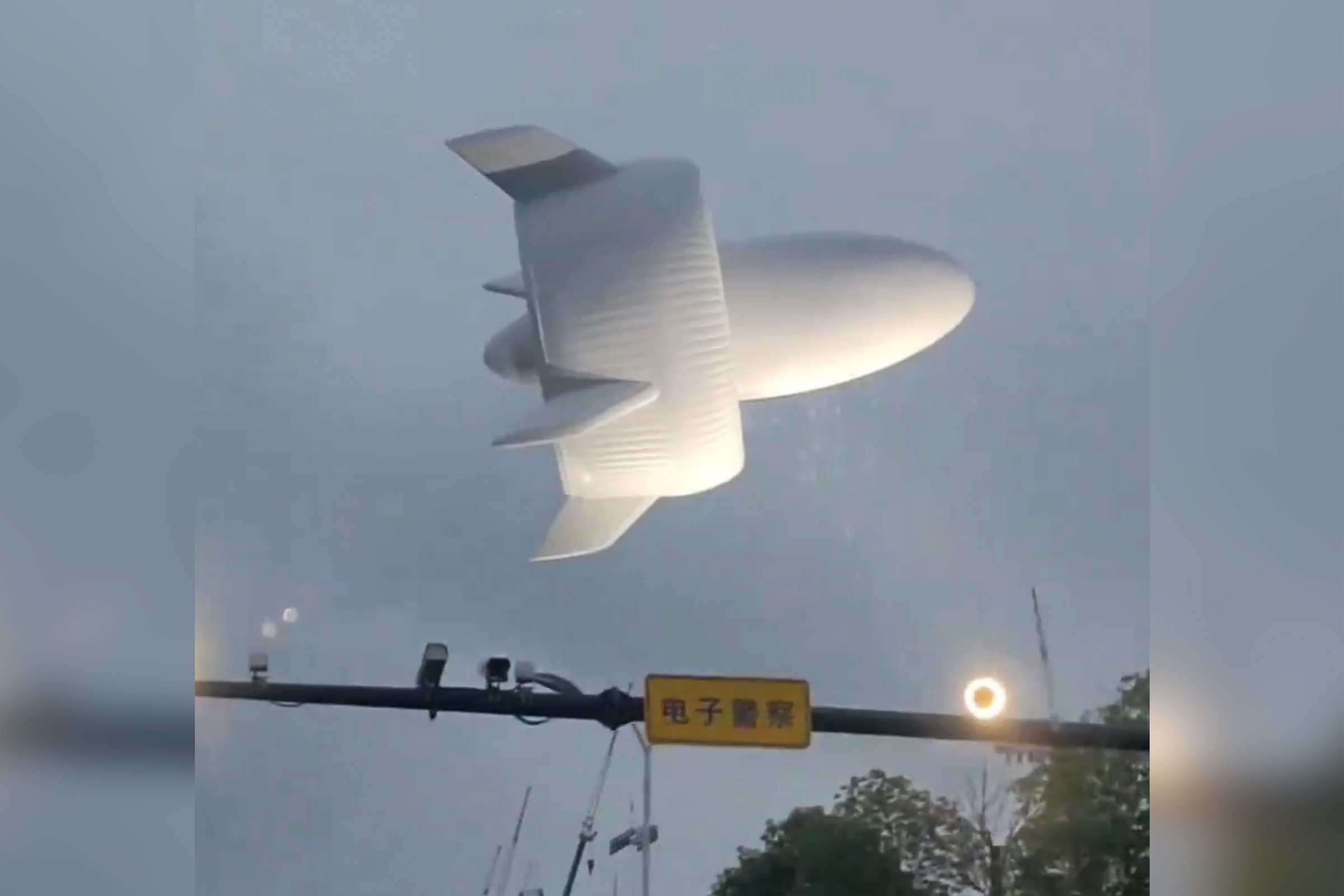
A new airborne wind turbine (AWT) prototype has made headlines in China, showcasing innovative technology aimed at harnessing high-altitude winds. The device, developed by the Chinese energy company Linyi Yunchuan, was filmed hovering over Sichuan Province in a video shared by journalist Li Zexin on January 9, 2026. This prototype is part of China’s ongoing efforts to expand its renewable energy capabilities, which are already among the most advanced in the world.
The airborne wind turbine, identified as the SAWES S2000, is designed to float at high altitudes to capture stronger and more consistent winds. It was developed in collaboration with institutions like Tsinghua University and the Institute of Aeronautics and Astronautics of the Chinese Academy of Sciences. According to reports from the Global Times, the SAWES S2000 successfully completed a test flight, marking a significant milestone in renewable energy technology.
During its test flight, the SAWES S2000 achieved a maximum altitude of approximately 6,500 feet and remained airborne for about 30 minutes. In that time, it generated around 385 kilowatt-hours of electricity and connected to the local power grid, a first for AWTs. Its potential output is impressive, with the capability to produce up to 3 megawatts of energy. This amount is sufficient to fully charge around 30 high-end electric vehicles in just one hour of operation, according to Dun Tianrui, the chief designer of the system.
The innovative design of the SAWES S2000 allows for easy transport and storage in shipping containers. The inflation process for the AWT takes approximately eight hours, but with efficient coordination of helium supplies, this could be reduced to four to five hours. The AWT operates similarly to airships, lifting lightweight turbine-generators into high-altitude wind streams without the need for extensive ground support.
The success of the SAWES S2000 follows the earlier deployment of the SAWES S1500, which flew successfully in September 2025. The S1500 has a generator capacity of 1.2 megawatts and is comparable in size to a basketball court while standing as tall as a 13-story building. It became the first of its kind to generate a full megawatt of power during its inaugural flight.
These advancements come at a time when China’s carbon dioxide emissions have reportedly decreased for the first time on a year-over-year basis, attributed largely to the growth of renewable energy sources like wind and solar. As the world leader in solar power and offshore wind energy, China’s development of airborne wind turbines represents a logical continuation of its commitment to green energy.
The unveiling of the SAWES S2000 not only highlights China’s ambitious energy strategies but also sets a precedent for the future of renewable energy technology globally.