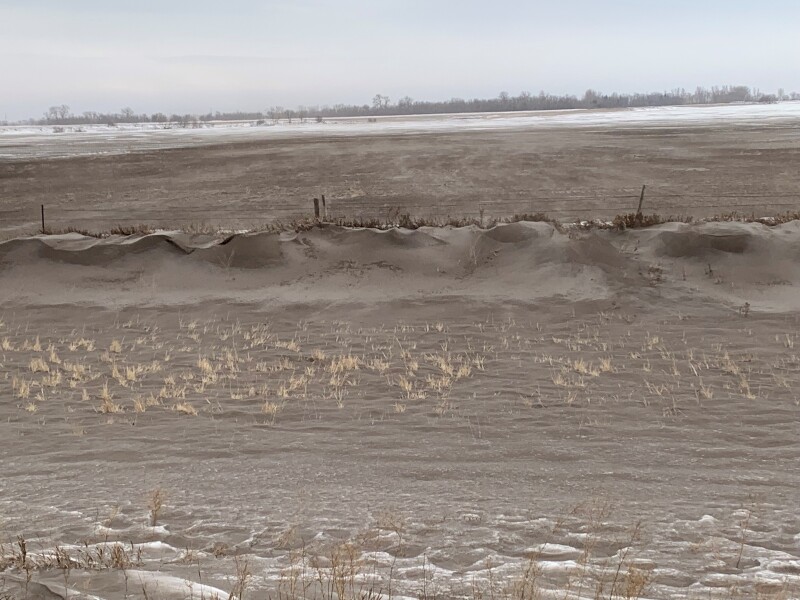
Research from North Dakota State University (NDSU) highlights the significant economic impact of topsoil erosion, estimating that losing just 6 inches of this vital layer can cost farmers over $6,600. The study, conducted by NDSU researchers, underscores the essential role topsoil plays in crop production, as it is rich in nutrients and supports microbial activity crucial for healthy plant growth.
According to the findings, the financial loss from direct nutrient depletion and the associated organic matter loss amounts to more than $1,100 for every inch of topsoil lost. This equates to a total cost of approximately $6,600 for a 6-inch loss. Naeem Kalwar, a soil health specialist at the NDSU Langdon Research Extension Center, emphasizes that addressing soil erosion is not only an environmental concern but also a critical economic issue for farmers.
“Protecting topsoil from erosion is crucial,” Kalwar states. “That layer is where farmers plant seed, and it is responsible for feeding the world.”
Soil erosion occurs through various processes, including wind, water, and tillage, which can exacerbate the loss of topsoil. When topsoil washes into roadside ditches, it not only leads to nutrient loss but also contributes to water pollution, affecting both human and livestock drinking supplies. Kalwar notes that farmers, ranchers, and landowners will ultimately incur costs to replace these lost nutrients.
To assess the economic value of topsoil, researchers collected a 6-inch sample that had eroded into a roadside ditch from a nearby field. This sample underwent a comprehensive fertility analysis at a soil testing laboratory. The results indicated a substantial loss of essential plant nutrients and organic matter. The calculated cost to replace nitrogen, phosphorus, potash, sulfate-sulfur, and iron lost due to the erosion was approximately $2,541.22, translating to $423.54 for each inch of topsoil.
Additionally, the costs associated with replacing nutrients linked to organic matter loss added another $4,141.73, resulting in a combined total of $1,113.82 per inch of lost topsoil, or about $6,682.95 for 6 inches.
While fertilizers can mitigate nutrient loss, restoring soil organic matter is a much longer process. Research from the NDSU Carrington Research Extension Center found that soil organic matter increases by just 1% after 27 years of consistent livestock manure application. At that rate, it could take approximately 154 years to replace the 5.7% of organic matter lost from a 6-inch layer of topsoil.
“Preventing erosion is far more cost-effective than trying to rebuild the soil,” Kalwar asserts. He advocates for practices such as reduced tillage and cover crops, which can save farmers significant amounts over time.
For detailed insights, the full research report can be accessed at ndsu.ag/erosion-cost. For more information on effective strategies to protect soil health and prevent erosion, visit ag.ndsu.edu/soilhealth.