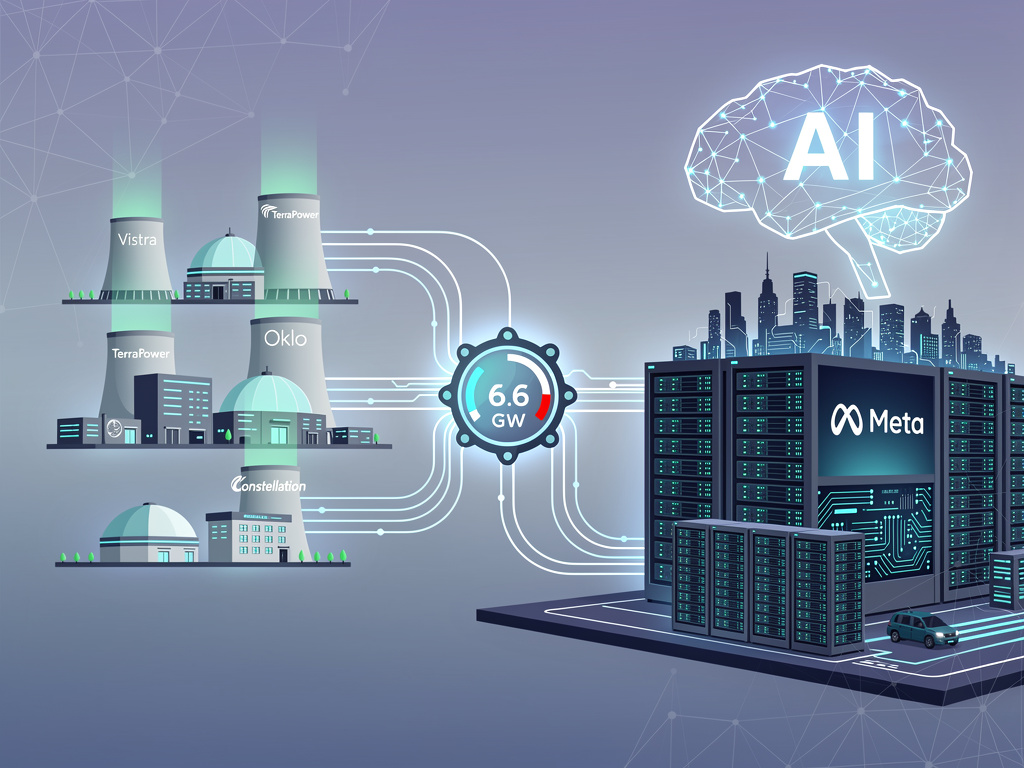
Meta Platforms Inc. has embarked on an unprecedented energy procurement strategy, securing agreements that could provide up to 6.6 gigawatts of nuclear power to support its artificial intelligence (AI) infrastructure. Announced on January 9, 2026, these agreements with Vistra Corp., TerraPower LLC, Oklo Inc., and Constellation Energy Corp. position Meta as a leading force in revitalizing U.S. nuclear capacity in response to increasing electricity demands driven by AI technologies.
The agreements include long-term power purchase contracts from three existing Vistra nuclear plants located in the Midwest, along with development assistance for advanced small modular reactors (SMRs) from TerraPower and Oklo. Meta’s official blog heralded the pacts as “landmark agreements” that will enhance plant operations, promote technological advancements in nuclear energy, and generate jobs across American communities. This strategic move comes as major technology companies face escalating power requirements for data centers, which could soon rival the electricity consumption of small nations.
Addressing the AI Energy Demand
The surge in AI training and inference workloads has significantly increased power requirements for major tech firms. Meta’s upcoming Prometheus AI supercluster, designed to expand the scale of AI models, necessitates a reliable supply of carbon-free baseload power. Current renewable sources alone cannot adequately meet these demands. According to recent estimates, U.S. data centers may consume as much as 8% of the nation’s electricity by 2030.
Meta’s recent agreements build upon its past commitments to renewable energy but mark a strategic pivot towards nuclear power, which offers greater energy density and reliability. The Wall Street Journal indicated that the energy generated from these agreements could potentially power a city of five million homes. Following the announcement, Vistra’s stock surged by as much as 16%, reflecting investor optimism regarding the nuclear revival.
Details of the Agreements
Under the agreements with Vistra, Meta has signed 20-year power purchase contracts for energy generated from plants in Illinois, Pennsylvania, and Texas, effectively extending their operational lifespans. Constellation Energy, recognized as the largest nuclear operator in the U.S., is involved in capacity expansions. As highlighted by Meta executive Joel Kaplan in a post on X, these deals establish Meta as “one of the most significant corporate purchasers of nuclear energy in American history.”
The partnerships with TerraPower, supported by Bill Gates, and Oklo, backed by Sam Altman, are aimed at advancing next-generation reactor technologies. These small modular designs promise quicker deployment and reduced costs. Meta’s financial commitments include funding site development and licensing for these innovative projects, which are expected to launch in the late 2020s.
Joel Kaplan emphasized the strategic significance of these agreements on X, stating, “Our agreements with Vistra, TerraPower, Oklo, and Constellation will help power our AI future, strengthen our country’s energy infrastructure, and provide clean energy.” This statement aligns with national energy priorities, reflecting a broader shift away from dependence on natural gas towards more stable and sustainable nuclear power.
Economic and Community Impacts
The implications of these agreements extend beyond energy supply. The projects are expected to create thousands of high-wage jobs in construction, operations, and supply chains, with Vistra’s plants already employing hundreds. Meta’s blog underlines the anticipated job growth in American communities as a key benefit of these initiatives. Local opposition, often linked to safety concerns, has diminished following advancements in reactor technology, particularly in the aftermath of the Fukushima disaster.
Additionally, the economic benefits associated with these projects, including increased tax revenues and infrastructure improvements, are likely to bolster community support. By 2035, Meta’s nuclear fleet could potentially reduce carbon dioxide emissions by 20 million tons annually when compared to natural gas alternatives. This could elevate the share of nuclear energy in the U.S. power mix from 19% to a significantly higher percentage, reinforcing the country’s transition to cleaner energy sources.
The recent agreements signify a crucial advancement in Meta’s long-term energy strategy, setting a precedent for how major corporations can align their energy needs with sustainability goals. As Meta seeks to integrate nuclear power into its operations while maintaining a commitment to renewable energy, the company is poised to redefine corporate energy strategies on a global scale.