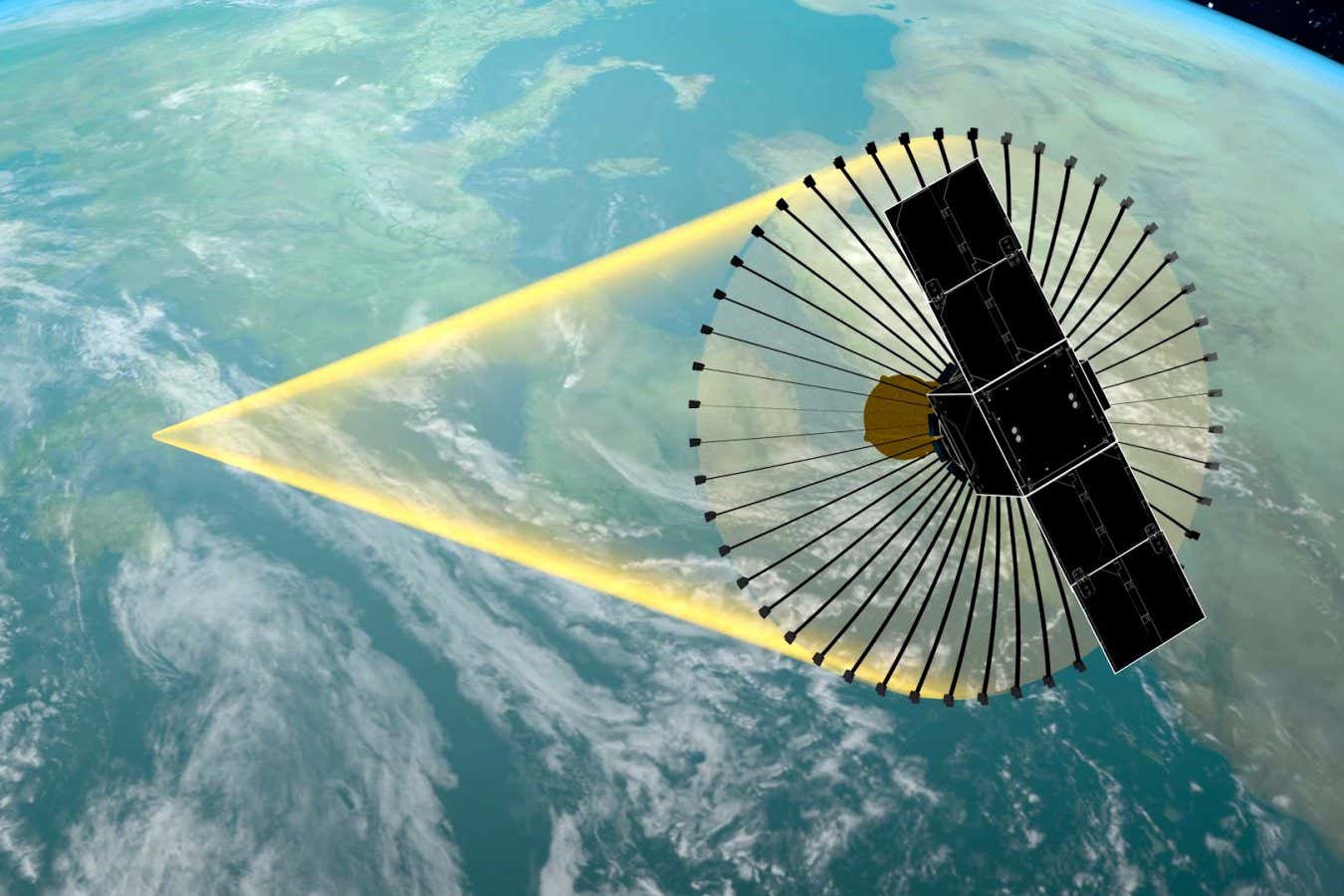
The United Kingdom is preparing to launch the CarbSAR satellite on March 10, 2024, which will utilize advanced radar technology to monitor the Earth’s surface. This innovative satellite, developed by Oxford Space Systems (OSS) in collaboration with Surrey Satellite Technology Limited (SSTL), will feature a unique mesh radar antenna fabricated using a knitting machine typically found in textiles manufacturing.
The CarbSAR satellite will be deployed into orbit on Sunday. Its antenna is crafted from ultra-fine tungsten wire coated in gold, allowing it to capture high-resolution images of the Earth. According to Amool Raina, production lead at OSS, “It’s a very standard, off-the-shelf industrial machine used for knitting jumpers. All we’ve done is add some bells and whistles to let it stitch our special yarns.”
Innovative Design for Efficient Launch
The satellite’s antenna is designed to be compact for launch. It consists of mesh sheets that can be cut and sewn into a parabolic dish, measuring just 3 millimeters in width, which, when stretched over 48 carbon-fibre ribs, forms an effective radar imaging structure. This wrapped-rib design allows the entire satellite to reduce its diameter to just 75 centimeters, significantly enhancing its launch efficiency.
Once in orbit, the satellite will utilize stored strain energy to deploy the antenna into its operational shape. Sean Sutcliffe, CEO of OSS, emphasized the precision needed for the antenna to achieve the ideal parabolic configuration. “But for the imaging we want to do, we also need to unfurl with precision – to get that perfect parabolic shape,” he explained. Testing has shown that the mesh sheets maintain their shape within a millimeter of the ideal configuration.
The demand for Earth observation through small radar satellites is increasing, particularly due to their ability to capture images in various weather conditions and at night. This capability has gained attention from military organizations globally, especially during conflicts, such as the ongoing situation in Ukraine.
Potential for Future Development
The UK has historically been a leader in space radar technology, but recent years have seen it fall behind international competitors. The launch of CarbSAR is part of a broader initiative to regain prominence in this field, with future projects like the Oberon constellation planned for the British Ministry of Defence (MoD) as part of the ISTARI programme.
Andrew Cawthorne, managing director of SSTL, noted the growing interest from foreign governments in the satellite’s radar capabilities. “Obviously, the first thing we need to do is deploy this antenna and prove we can take an image,” he stated. The CarbSAR is expected to discern objects as small as 50 centimeters, thus providing vital intelligence for military applications.
As the satellite prepares for launch, Major General Paul Tedman, commander of UK Space Command, expressed enthusiasm for the project. “CarbSAR is a testament to the innovation and collaboration of one of the UK’s most forward-thinking space companies,” he remarked. The upcoming launch is being closely monitored, and the successful deployment of the antenna will be critical in determining the satellite’s future applications within the UK’s space strategy.