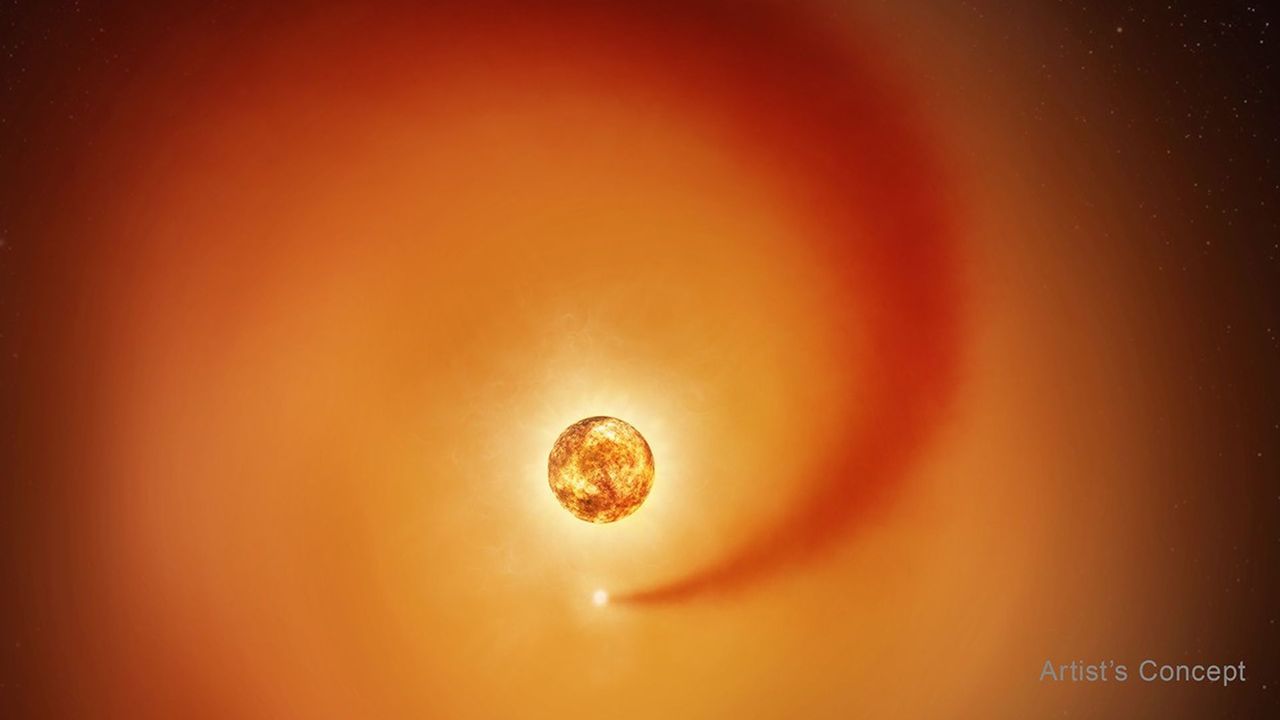
Astronomers have confirmed the existence of a companion star orbiting the red supergiant star Betelgeuse, using data from the Hubble Space Telescope and terrestrial observatories. This finding sheds light on the unusual behavior of Betelgeuse, which has been noted for its dimming and brightening patterns. The companion star, named Siwarha, was detected in July 2025 and is believed to significantly influence Betelgeuse’s outer atmosphere.
New observations reveal a wake generated by Siwarha, providing crucial evidence for its existence. According to Andrea Dupree, an astronomer at the Center for Astrophysics | Harvard & Smithsonian, “The idea that Betelgeuse had an undetected companion has been gaining in popularity for the past several years, but without direct evidence, it was an unproven theory.” The new data allows scientists to monitor the evolution of giant stars like Betelgeuse, particularly how they shed material and eventually explode as supernovae.
Significance of the Discovery
Utilizing the combined capabilities of the Hubble Space Telescope, the Fred Lawrence Whipple Observatory in Arizona, and the Roque de Los Muchachos Observatory in the Canary Islands, researchers identified a distinctive pattern of changes in Betelgeuse. They were able to recognize Siwarha’s wake, which is characterized by denser material compared to the surrounding gases of Betelgeuse’s atmosphere.
The research team noted that every six years, when Siwarha aligns between Betelgeuse and Earth, the wake becomes visible. This phenomenon alters the spectrum of colors emitted by various elements within the star’s atmosphere. Dupree likened this effect to “a boat moving through water,” explaining how the companion star creates a ripple effect in Betelgeuse’s atmosphere that is observable in the collected data.
Future Observations
This discovery marks the first time scientists have seen direct evidence of the wake, confirming that Betelgeuse is indeed influenced by a hidden companion. Siwarha is expected to be visible again in 2027, prompting researchers to plan additional observations for that year.
The findings regarding Siwarha’s wake were shared at the 247th meeting of the American Astronomical Society in Phoenix, Arizona, and will be published in The Astrophysical Journal. This research not only enhances our understanding of Betelgeuse but also offers a valuable opportunity to study the life cycles of massive stars in our galaxy.