Researchers from Zhejiang Gongshang University have discovered that natural plant extracts can significantly reduce the risks posed by human bacterial pathogens in manure-amended soils. Published in the journal Biocontaminant on 26 November 2025, the study led by Meizhen Wang reveals a novel approach that disrupts bacterial communication, rather than relying on traditional methods that kill bacteria outright.
The application of manure is vital for maintaining soil fertility and enhancing crop yields. However, this practice can introduce human bacterial pathogens (HBPs) into agricultural environments. These pathogens often carry antibiotic resistance genes (ARGs) and virulence factor genes (VFGs) that can spread through mobile genetic elements (MGEs), thereby threatening both ecosystems and human health.
Existing strategies to mitigate these risks, such as biochar and engineered nanoparticles, can be costly and raise environmental concerns. The innovative use of plant-derived compounds presents a promising alternative, with previous research highlighting their potential for soil remediation and plant protection. Yet, their specific impact on soil-borne HBPs and the transfer of harmful traits had not been extensively studied until now.
In this comprehensive study, the research team utilized manure-amended soil microcosms, along with advanced techniques like metagenomic profiling and molecular docking analyses, to assess the effects of three key plant extracts: curcumin (CUR), andrographolide (AG), and thymol (THY).
323 HBPs were identified from a curated pathogen database, and the team monitored changes in their abundance, community composition, and diversity after treatment with the plant compounds. In addition to monitoring these pathogens, the researchers quantified the levels of ARGs, VFGs, and MGEs to better understand the potential for pathogenicity and gene transmission.
The findings indicated that plant extracts reduced the total abundance of HBPs by approximately 25–28%. Notably, the study recorded a selective suppression of pathogens associated with Actinobacteria and Proteobacteria, while overall richness declined without significant alterations in alpha diversity. Additionally, key risk indicators showed a substantial decrease, with ARGs reduced by roughly 20–27%, VFGs by 6–11%, and MGEs by 25–34%.
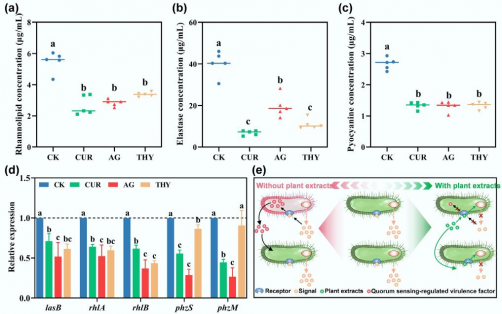
Analysis revealed that the plant extracts disrupted the quorum sensing (QS) systems of these pathogens by reducing the abundance of QS-related genes and decreasing the concentrations of acyl-homoserine lactone signals. This disruption led to a corresponding decline in virulence factor secretion, a reduction of up to 40% in biofilm formation, and an impressive 90% suppression of conjugative ARG and VFG transfer.
Molecular docking studies confirmed that these plant compounds bind to the QS receptor LasR with greater affinity than native signal molecules, obstructing signal recognition and communication among bacteria. This mechanism illustrates that plant extracts mitigate the risks associated with soil-borne pathogens primarily by disrupting microbial communication and gene exchange, rather than through direct bactericidal effects.
The implications of these findings are significant. If adopted widely, plant extracts could serve as environmentally friendly soil amendments that reduce the health risks linked to the use of manure. Unlike traditional antibiotics or nanomaterials, these compounds function by disarming pathogens instead of killing them, thus lessening the selective pressure for resistance.
The research received funding from the “Leading Goose” R&D Program of Zhejiang and the National Key R&D Program of China, among other sources. As the agricultural community seeks sustainable practices, this study opens new avenues for reducing pathogen risks while promoting healthy soil ecosystems.
For further details, the original study can be accessed at: https://doi.org/10.48130/biocontam-0025-0009.