
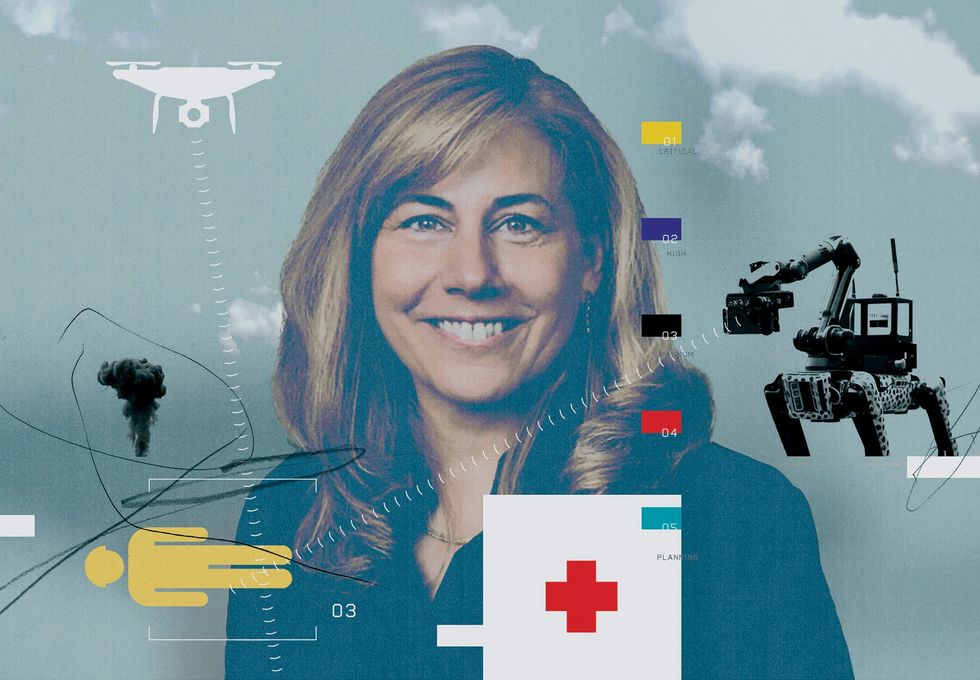
The Defense Advanced Research Projects Agency (DARPA) has launched an innovative competition aimed at enhancing battlefield medical response through robotics. In September 2024, DARPA deployed teams of robots in simulated mass-casualty scenarios, such as an airplane crash and a nighttime ambush. The objective was clear: these robots must locate victims and assess the severity of their injuries to assist human medics in prioritizing care effectively.
The final event of the DARPA Triage Challenge is set to take place in November 2024. Among the competitors is Team Chiron from Carnegie Mellon University, led by Kimberly Elenberg. With a distinguished career spanning 28 years in the U.S. Army and the U.S. Public Health Service, Elenberg has extensive experience in combat surgical teams and incident response strategy at the Pentagon.
Enhancing Emergency Response with Robotics
The necessity for robotic assistance in triage is underscored by Elenberg’s assertion that there are simply not enough responders available for mass-casualty incidents. She explained that the drones and ground robots being developed can provide critical perspectives to identify victims, assess their risk levels, and determine the most efficient routes for responders.
Reflecting on a real-life incident prior to one of the challenge events, Elenberg recounted a four-car accident where she had to assess victims without additional support. “I could hear some people yelling and see others walking around, and so I was able to reason that those people could breathe and move,” she said. In contrast, she described how a robot could have helped to identify victims in more precarious situations by remotely collecting vital data such as heart rates or breathing patterns.
Innovations in Triage Technology
To design technology specifically for triage, Elenberg emphasizes simplicity. The team has developed a vest-mounted Android phone that displays a map indicating the GPS locations of casualties and their triage priorities, represented by colored dots. This information is autonomously populated by the robots, allowing medics to maintain their focus on patient care.
When asked about the capabilities of the robots, Elenberg expressed optimism tempered by realism. “The only way to understand true capability is to build it, test it, and break it,” she noted. Through this challenge, she is learning about the integration of sensing, communications, and autonomy in real-world environments. While she acknowledges that the technology has its limitations, she also highlights the extraordinary pace of progress in this field.
Elenberg considers any advancement in showing responders precisely where casualties are and estimating who requires immediate attention a significant victory for disaster medicine. As she looks to the future, she envisions the next milestone as robots being able to recognize specific injury patterns and identify life-saving interventions, which she believes is an attainable goal.
The DARPA Triage Challenge not only represents a step forward in medical technology but also stands as a testament to the potential of robotics in saving lives on the battlefield. As November approaches, the anticipation builds around the competition and the innovations that may emerge from it.


