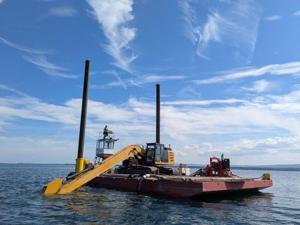
Recent efforts to restore fish habitats in Lake Erie have implemented a cutting-edge technique known as high-velocity jetting. This innovative approach aims to enhance conditions for the lake’s trout population, particularly in areas affected by sediment accumulation. The project, conducted by Seaway Marine Group and supported by the New York State Department of Environmental Conservation, focuses on the Brocton Shoal region in Chautauqua County.
The jetting process involves using a high-tech power washer to blast away layers of sediment, which can hinder fish spawning and reduce habitat quality. This project not only aims to improve the habitat for the lake trout but also to ensure the overall health of the aquatic ecosystem in Lake Erie.
Prior to the jetting, assessments were conducted to evaluate the current conditions of the underwater environment. Pascal Wilkins, a fish biologist with the Lake Erie Fisheries Research Unit, along with Aleksandr Davis, a fish technician with Region 9 fisheries, utilized an underwater drone to monitor both pre- and post-jetting conditions. Their assessments revealed promising initial results, suggesting that the technique effectively removed a significant amount of sediment.
The need for such intervention arises from ongoing environmental challenges facing Lake Erie. Increasing sedimentation can be attributed to a variety of factors, including agricultural runoff and urban development, which can severely impact fish populations. The high-velocity jetting represents a proactive strategy to combat these issues and support the recovery of local fish species.
As the project progresses, continued monitoring will be essential to determine the long-term effectiveness of this restoration technique. The collaboration among state agencies and marine contractors highlights a commitment to preserving and enhancing the natural resources of Lake Erie.
By revitalizing critical habitats, officials hope to foster a more resilient ecosystem, supporting not only trout but a diverse range of aquatic life. Local stakeholders and environmental advocates will be closely watching the outcomes of this innovative project as part of broader efforts to protect and restore the health of Lake Erie.