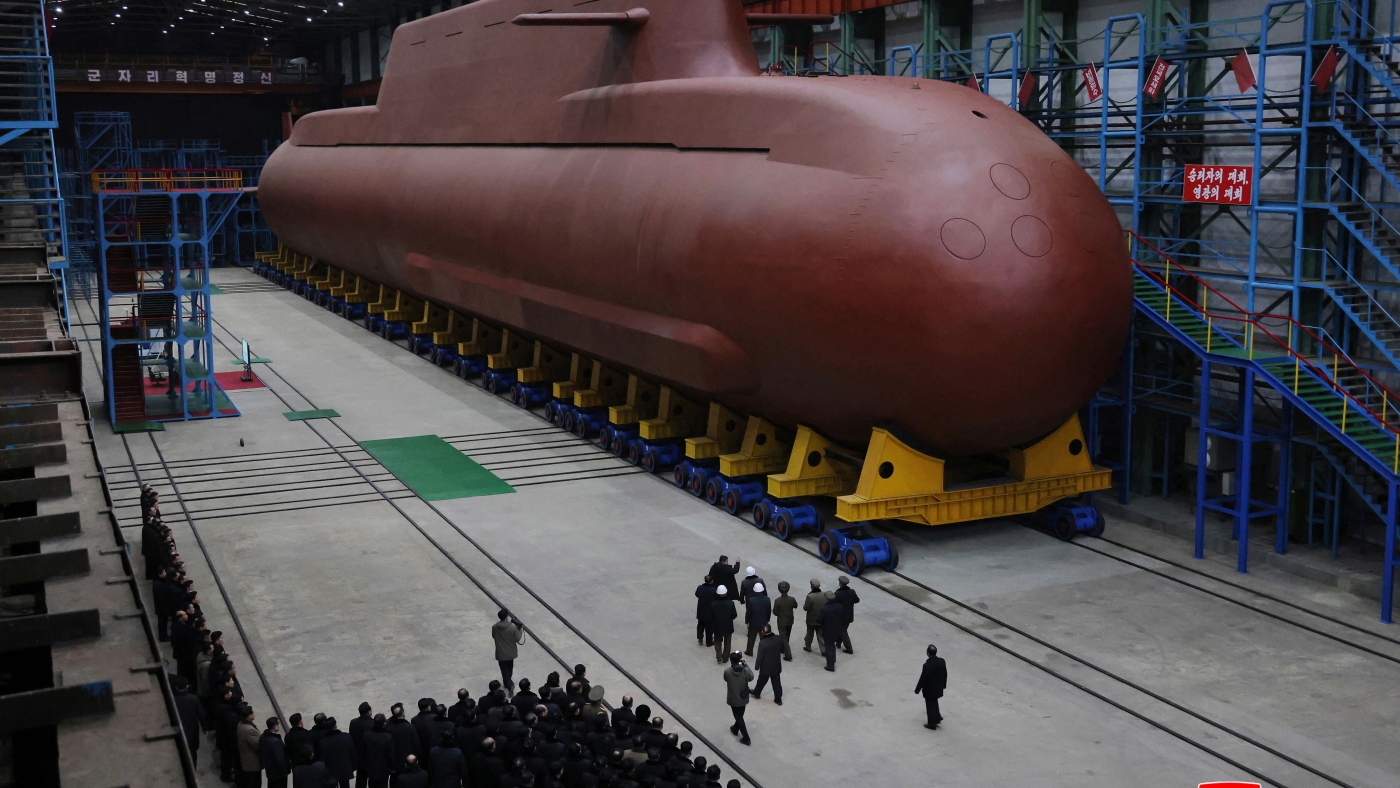
The development of nuclear-powered submarines is intensifying between North and South Korea, reflecting shifts in the United States’ security strategy in the region. North Korea’s state media recently unveiled an image of its new submarine, described as an “8,700-ton nuclear-powered strategic guided missile submarine.” This announcement marks the first time North Korea has disclosed the tonnage and the completed hull of the vessel since it began pursuing nuclear submarines in 2021.
North Korean leader Kim Jong Un emphasized that the new submarine is essential for defending the nation against what he termed “the negative security situation that has come as present reality.” He criticized South Korea’s plans to develop its own nuclear submarines, labeling them as “an offensive act … that must be countered.”
South Korea has been responsive to North Korea’s advancements, rapidly moving to establish its own nuclear submarine program after receiving approval from President Trump in October 2023. A pan-government task force was launched last week in Seoul, with the country’s national security adviser, Wi Sung-lac, stating that South Korea will seek a pact with the U.S. for military-use nuclear fuel. This initiative aligns with U.S. efforts to encourage allies to take greater responsibility for their security and enhance their defense capabilities.
Strategic Implications for Regional Security
The push for nuclear submarines in South Korea comes in response to North Korea’s expanding nuclear threats, which have increasingly included maritime capabilities. In addition to developing its nuclear submarine, North Korea has conducted tests of submarine-launched nuclear missiles and claims to have developed a nuclear-capable torpedo. Ahn Gyu-back, South Korea’s defense minister, stated that conventional, diesel-powered submarines “can’t compete with nuclear submarines North Korea is building in underwater endurance and speed.”
The U.S. anticipates that South Korean nuclear submarines will play a broader role in regional security beyond countering North Korea. During his visit to Seoul, Admiral Daryl Caudle, chief of naval operations for the U.S. Navy, indicated that it is a “natural expectation” for these submarines to help address what the U.S. considers its “pacing threat,” which is China.
President Lee Jae Myung acknowledged this expectation during a summit with Trump, noting that the limited underwater range of diesel submarines hampers South Korea’s ability to effectively monitor activities on both the North Korean and Chinese coasts. Retired South Korean navy captain Yoon Sukjoon emphasized that extending nuclear submarine operations beyond the Korean Peninsula could provide strategic deterrence against the Chinese Navy’s activities in the Indo-Pacific.
While South Korea moves forward with its submarine ambitions, the government remains cautious about suggesting military confrontation with China, its largest trading partner. Following Lee’s comments, his office clarified that references to submarines were not aimed at specific countries. This careful stance reflects the sentiments of the South Korean public, with a recent survey indicating that a majority believe South Korea should remain neutral in the event of a conflict between the U.S. and China.
Concerns and Future Directions
Both South Korea and Japan are increasingly concerned about China’s expanding influence and military capabilities. Political scientist Kim Heungkyu from Ajou University noted that as the U.S. shifts its defense focus closer to home, allies in the region are becoming more distrustful of American security commitments. A poll conducted by the Asan Institute in March revealed that less than half of Koreans are confident the U.S. would respond with nuclear weapons if North Korea were to attack the South.
Despite governmental denials of an intention to pursue nuclear armament, the sentiment among the South Korean populace is shifting. A majority supports nuclear development, even if it results in international sanctions or the withdrawal of U.S. troops. As Kim stated, “In a new international order without the U.S. in the Western Pacific, South Korea needs a survival strategy based on nuclear weapons.” He argued that nuclear-powered submarines could serve as an “entry point toward a much bigger goal” of nuclear armament.
The South Korean government is also pursuing access to uranium enrichment and reprocessing spent fuel in discussions with the U.S., which adds another layer of complexity to the regional security landscape. As both North and South Korea advance their nuclear submarine capabilities, the implications for security in East Asia continue to evolve, raising critical questions about the future balance of power in the region.