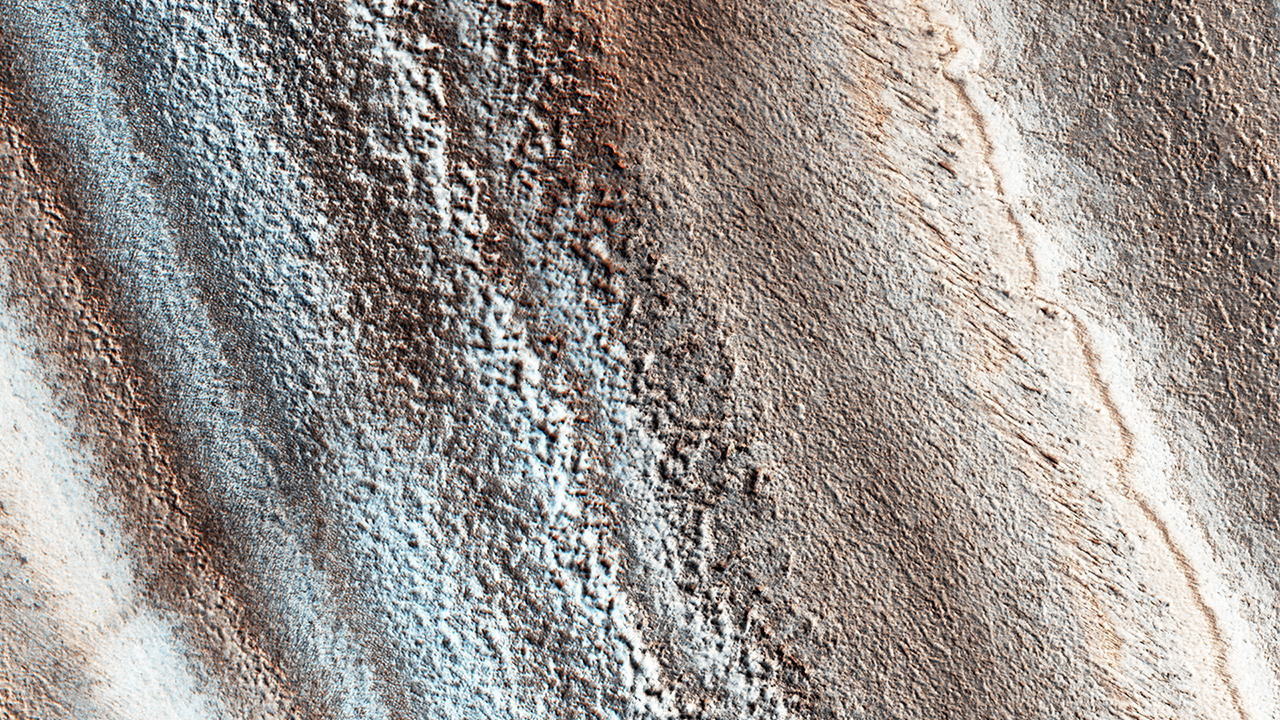
Recent observations from the Martian North Pole have uncovered a striking feature that cuts across multiple layers of deposits, revealing significant variations in their brightness. This straight-line streak, identified in high-resolution images from the High-Resolution Imaging Science Experiment (HiRISE), suggests a notable shift in the properties of these layers.
The feature appears to be superficial, likely resulting from wind processes that have either removed frost or deposited dust unevenly along one side of the streak. As a result, the visual characteristics of the layers on either side differ dramatically, complicating the interpretation of their properties based solely on brightness.
Understanding the Impact of Wind on Martian Layers
When examining the full scale of the HiRISE images, the textural differences across the streak remain minimal, indicating that the changes are primarily surface-level. Some layers that exhibit brighter characteristics on one side appear darker on the opposite side. This phenomenon likely results from the interaction of local slope and roughness with wind patterns, making it challenging to accurately assess the physical properties of the layers based on their visual appearance.
The findings highlight the complexities of interpreting Martian geology, particularly in regions influenced by atmospheric conditions. The layers, which are critical for understanding Mars’ past climate and potential habitability, may not present their true composition or history due to these superficial alterations.
Implications for Astrobiology and Astrogeology
These observations are significant for both astrobiology and astrogeology, fields that seek to understand the potential for life on Mars and the planet’s geological history. The ability to differentiate between actual geological changes and superficial alterations caused by environmental factors is crucial for future exploration and research.
As scientists continue to analyze data from the HiRISE, further insights into the Martian environment and its layered deposits are expected. Understanding these features not only informs our knowledge of Mars but also aids in the broader quest to assess planetary habitability and geological processes across the solar system.
In summary, the discoveries at Mars’ North Pole underscore the importance of advanced imaging techniques in unraveling the complexities of extraterrestrial geology. The interplay of wind and geological layers presents both challenges and opportunities for researchers dedicated to exploring the Red Planet.