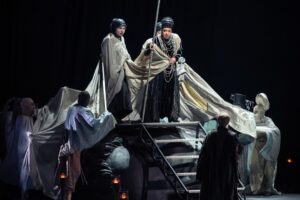
The Wiener Staatsoper recently unveiled a powerful revival of Richard Strauss’s one-act opera, “Elektra,” as part of its 2025-26 season. This production, directed by Harry Kupfer, immerses audiences in the intense psychological landscape of Elektra, a woman consumed with vengeance for her father, Agamemnon, who was murdered by her mother, Klytämnestra. With a libretto by Hugo von Hofmannsthal, the opera explores themes of obsession and trauma, enhanced by Strauss’s complex and dissonant score.
Impressive Production Elements
The staging is dominated by a striking black void, featuring a fragmented statue of Agamemnon that looms over the action. This stark setting creates a haunting atmosphere, skillfully illuminated to reflect the emotional turmoil of the characters. Conductor Alexander Soddy established a palpable tension from the outset, leading the Vienna State Opera Orchestra in a performance marked by lush orchestral textures and sharp contrasts. The orchestra’s ability to weave between moments of chaos and lyrical beauty was a testament to their skill and sensitivity.
The opera centers around the character of Elektra, who is portrayed with relentless intensity. Ausrine Stundyte takes on this demanding role, delivering an emotionally charged performance that captures Elektra’s descent into madness. While her voice possesses a lyrical quality, it occasionally struggled to maintain the raw power expected in the character’s most anguished moments. This contrast became particularly evident in her interactions with the formidable women of the cast.
Stellar Performances by Leading Ladies
In her role as Klytämnestra, the esteemed Nina Stemme made a remarkable debut, showcasing the complexities of a mother plagued by guilt and isolation. Stemme’s interpretation transformed Klytämnestra from a mere antagonist into a deeply sympathetic figure, as she navigated the character’s tragic backstory with a nuanced performance. Her entrance, adorned in jewels and an extravagant cape, was a visually striking moment that set the tone for her powerful portrayal.
Camilla Nylund, playing Chrysothemis, provided a delicate counterpoint to Elektra’s fury. Nylund’s portrayal of the younger sister effectively conveyed her horror at Elektra’s obsession with revenge. Her voice, radiant and sweet, offered a fresh perspective on the familial dynamics at play, adding depth to the emotional landscape of the opera.
In the role of Orest, Derek Welton brought a commanding presence to the stage. His deep bass-baritone voice resonated throughout the theatre, particularly during the pivotal reunion with Elektra. The chemistry between Welton and Stundyte highlighted the emotional stakes of the narrative, culminating in a moment that left a lasting impact on the audience.
The supporting cast, featuring various minor characters, enriched the production. Their performances contributed to the overall atmosphere, with particular praise for Jenni Hietala as the Fifth Maid, whose soprano voice soared effortlessly through the score.
As the opera reached its climax, Elektra’s ecstatic dance of death—interwoven with themes of revenge—culminated in a gripping finale. The act of vengeance, though not depicted on stage, resonated through the narrative, emphasizing the psychological turmoil that defines Strauss’s work.
The revival of “Elektra” at the Wiener Staatsoper was not only a testament to the enduring power of Strauss’s composition but also a showcase for the exceptional talent of the cast and creative team. The production’s success lies in its ability to blend visual artistry with profound emotional depth, ensuring that the themes of the opera resonate with contemporary audiences.