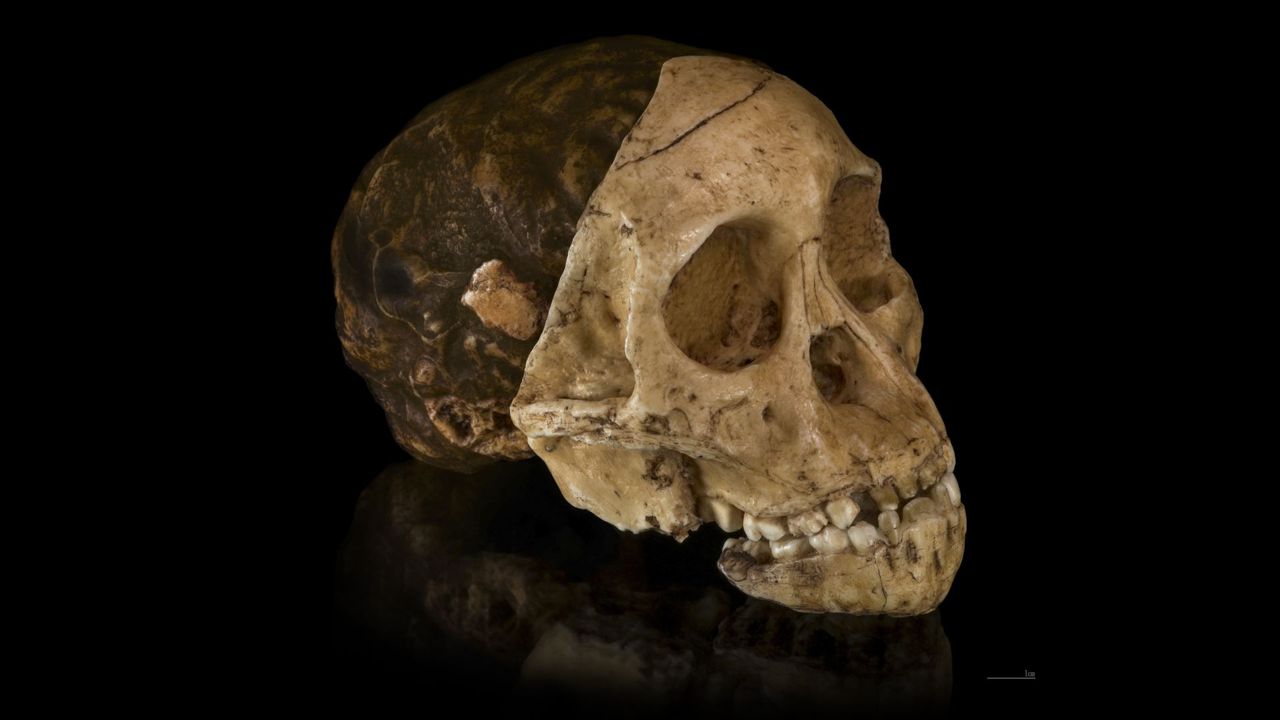
On December 23, 1924, a groundbreaking discovery reshaped our understanding of human evolution when anthropologist Raymond Dart began examining a fossilized skull known as the “Taung Child.” This skull, which resembled the size of a coffee mug, provided crucial evidence supporting the theory that Africa is the cradle of humanity. Dart’s work not only highlighted a new species but also confirmed Charles Darwin‘s hypothesis regarding a common ancestor shared by humans and nonhuman apes.
The story of the Taung Child begins not with Dart himself, but with a student, Josephine Salmons, who brought a baboon skull from a quarry to his class at the University of Witwatersrand in Johannesburg. The skull had been discovered at the Buxton Limeworks in Taung, South Africa, where local workers had previously unearthed it during blasting operations. Recognizing the potential significance of the find, Dart grew excited about the possibility of other ancient primate fossils lying within the same geological layers.
In late November 1924, Dart’s colleague, geologist Robert Young, contacted a quarryman named Mr. de Bruyn to search for additional fossils. De Bruyn later identified a brain cast embedded in rock and set it aside for Young. Young then personally delivered this cranium to Dart. Dart’s memoir, “Adventures with the Missing Link,” recounts the thrill he felt upon uncovering the skull, though he notably omits Young’s role in the delivery, instead implying a more dramatic discovery.
As Dart described in his memoir, “As soon as I removed the lid, a thrill of excitement shot through me. On the very top of the rock heap was what was undoubtedly an endocranial cast or mold of the interior of the skull.” His discovery on December 23 revealed the face of the Taung Child, although part of the skull remained encased in rock. Over the following weeks, Dart dedicated himself to analyzing the specimen.
On February 7, 1925, Dart published his findings in the journal Nature, introducing the world to Australopithecus africanus—the “Man-Ape of South Africa.” This marked the first time a nearly complete fossil skull of an ancient human ancestor had been identified. Dart’s analysis revealed that the skull’s molars corresponded anatomically to that of a human child, estimated to be around six years old, though later assessments suggested the child likely died at approximately three or four years of age. Most researchers currently believe the Taung Child was female.
Determining the age of the skull has proved challenging, as it was removed from its original context. Some estimates placed it at around 3.7 million years old, while more recent studies suggest it is closer to 2.58 million years. For nearly five decades, A. africanus was regarded as a direct ancestor of modern humans until another significant discovery in 1974 shifted the narrative.
In Ethiopia’s Afar region, scientists uncovered the fossil of a related species, dubbed Lucy, dating back 3.2 million years. This find led to a reevaluation of the evolutionary lineage, and A. afarensis, the species to which Lucy belongs, was promoted as a more direct ancestor than the Taung Child.
Interestingly, recent fossil fragments have prompted discussions about the evolutionary significance of A. africanus. Some researchers now propose that it could potentially regain its status as a direct ancestor, reigniting debate within the scientific community.
The discovery of the Taung Child remains a pivotal moment in anthropology, not only for its contribution to our understanding of human origins but also for the ongoing exploration of our evolutionary past. As new evidence emerges, the narrative of human evolution continues to evolve, illustrating the dynamic nature of scientific inquiry.