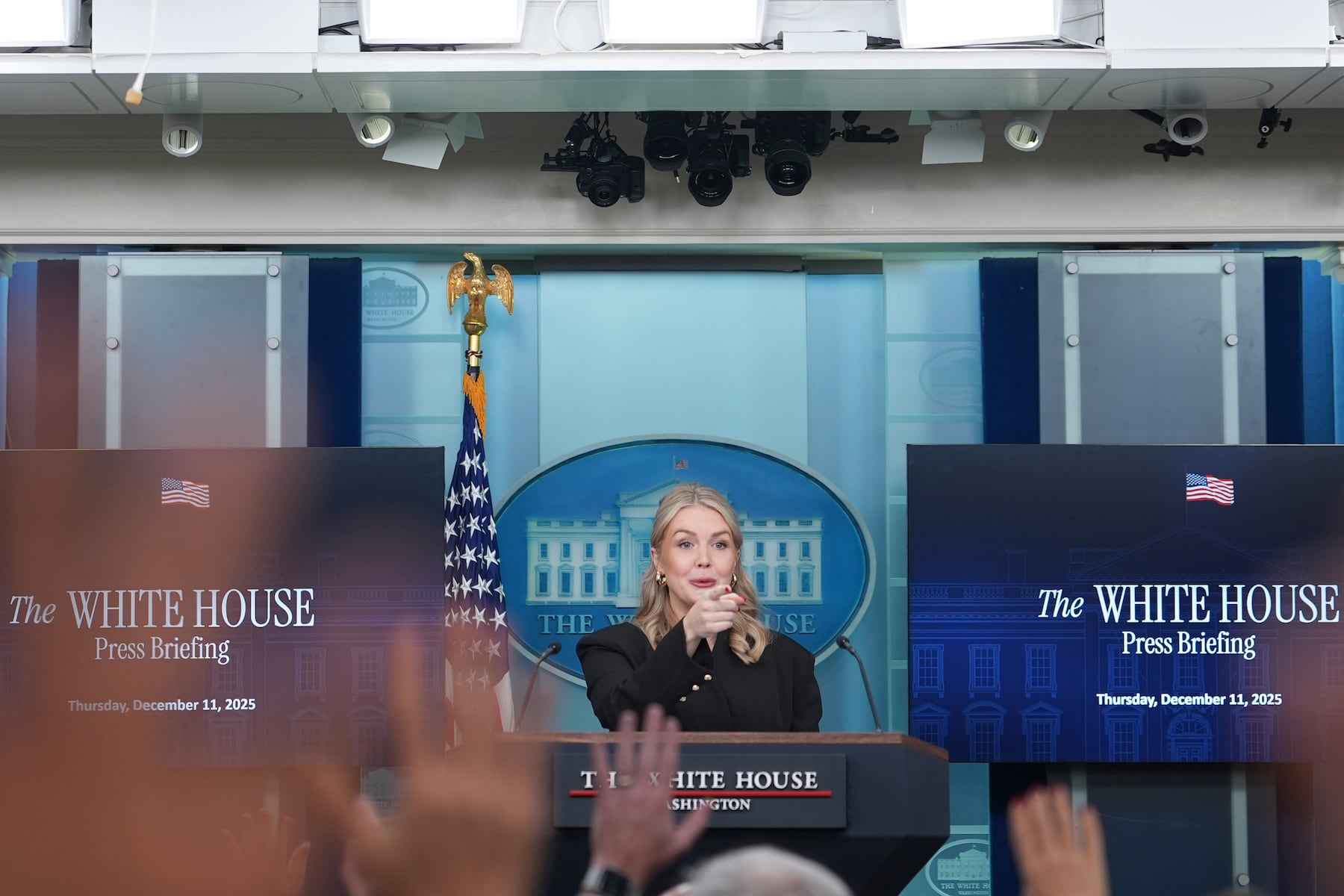
During a press briefing on December 11, 2025, White House Press Secretary Karoline Leavitt announced a positive shift in the economic landscape, claiming that inflation, as measured by the Consumer Price Index (CPI), had slowed to an average rate of 2.5%. She also stated that real wages had increased by approximately $1,200 for the average American worker.
However, when CNN political correspondent Kaitlan Collins attempted to follow up with a question, Leavitt diverted the conversation, launching an attack on her predecessor, Jen Psaki. Leavitt accused Psaki of delivering “utter lies” during her tenure and insisted that her statements were based on “real, factual data.”
Contrary to Leavitt’s assertions, the actual inflation rate for September was recorded at 3%, a figure that indicates a different economic reality than the one she presented. Additionally, CNN business editor David Goldman highlighted that U.S. workers experienced the lowest annual paycheck growth since May 2021, contradicting Leavitt’s claims of wage increases.
Echoes of Orwell in Political Discourse
The tone of Leavitt’s remarks has drawn comparisons to the themes presented in George Orwell’s dystopian novel, “1984.” As a historian familiar with Orwell’s ideas about truth and deception, the language used by Leavitt evokes the Ministry of Plenty, which disseminated distorted statistics to maintain the regime’s narrative. Orwell described this manipulation of truth, noting that it resulted in figures that “had no connection with anything in the real world.”
In her defense of President Donald Trump, Leavitt has repeatedly claimed that he is the “most transparent president in history.” Her assertions seem to mirror Orwellian “doublethink,” a term used to describe the ability to hold contradictory beliefs simultaneously. This concept resonates with Leavitt’s insistence that the Trump administration has provided unprecedented transparency, particularly regarding sensitive topics such as the Epstein files, a claim dismissed as “fabulously audacious” by The Guardian.
Orwell’s critique of political language, articulated in his essay “Politics and the English Language,” emphasizes the tendency of political discourse to obscure truth. In her role, Leavitt has made various claims about government initiatives that have turned out to be inaccuracies. For instance, she stated that the now-defunct U.S. Agency for International Development (USAID) provided a grant of $32,000 for a “transgender comic book” in Peru, which has been demonstrated to be untrue.
A Pattern of Misrepresentation
Leavitt has also mischaracterized legislative measures, such as the “One Big Beautiful Bill,” presenting it as eliminating taxes on tips, overtime, and Social Security, despite deductions for these being capped. Furthermore, she attributed the motto “peace through strength” to Trump, a phrase that has historical roots dating back to former President Ronald Reagan.
In recent statements, she sought to undermine a plea by U.S. Senator Mark Kelly and his colleagues to servicemen and women not to follow illegal orders, asserting that “all lawful orders are presumed to be legal.” This rhetoric raises concerns about the manipulation of language to deflect criticism and advance political agendas.
While all governments engage in some form of misrepresentation, Leavitt’s adept use of political language serves to bolster her boss’s image while belittling opponents and diverting attention from administration controversies. As the discourse around economic conditions and governmental transparency evolves, the implications of Leavitt’s statements resonate with Orwellian themes, prompting scrutiny of the narratives presented by those in power.