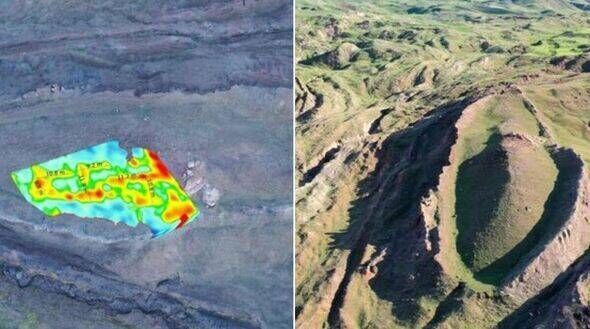
Archaeologists have made a significant discovery in Turkey, suggesting they may have found the remains of Noah’s Ark. Using Ground Penetrating Radar (GPR) technology, researchers identified a “chemical imprint,” pieces of wood, and a hall-like structure near the Durupinar Formation, located just 18 miles south of Mount Ararat. This area is historically linked to the Biblical account of Noah’s Ark, which is said to have saved humanity and various animal species from a catastrophic flood over 4,300 years ago.
The American research team from Noah’s Ark Scans, led by independent researcher Andrew Jones, conducted extensive GPR analysis, revealing angular formations and a hollow space within the formation. Notably, the scans indicated a corridor approximately 13 feet wide that slices through the core of the structure. Furthermore, the GPR data suggested the presence of central and side walkways throughout the possible craft, aligning with the Biblical description of the ark.
In an interview with The Christian Broadcasting Network (CBN), Andrew Jones stated, “We’re not expecting something that’s fully preserved. What’s left is the chemical imprint, pieces of wood, and the shape of a hall.” This finding adds weight to the ongoing debate regarding the ark’s resting place, which many believe to be on Mount Ararat following the flood described in the Book of Genesis. The Biblical text in Genesis 6:16 specifies the ark’s dimensions and structure, detailing “lower, second, and third decks.”
The Durupinar Formation gained public attention after heavy rains and seismic activity in May 1948 exposed it, allowing a Kurdish herder to discover the unusual shape. Since then, the site has been a focal point for both believers and skeptics. Some scholars argue that the formation is merely a natural rock structure, while others, including those at Noah’s Ark Scans, contend it indicates a man-made vessel.
Further analysis of the soil surrounding the formation has revealed intriguing results. William Crabtree, a colleague of Jones, highlighted that a passageway appears to extend from the tip of the formation towards its center, suggesting a space large enough for human passage. Their soil tests indicated that organic matter within the formation is double the amount found in the adjacent soil, with potassium levels elevated by approximately 40 percent. Crabtree explained, “If you know soil science, you’ll understand that potassium levels, organic matter, and pH can all be influenced by decaying organic material.”
The team plans to expand their soil testing beyond the current 22 specimens and is preparing for core drilling and additional GPR surveys. “We want to compare what’s inside the formation to what’s outside,” Andrew Jones noted. This comparative approach could clarify the nature of the structure, potentially confirming a man-made origin rather than a natural formation.
The findings at the Durupinar Formation continue to fuel public interest and debate regarding the historical accuracy of the Noah’s Ark narrative. As researchers delve deeper, the implications of their discoveries may contribute significantly to our understanding of ancient history and its intersection with modern science.