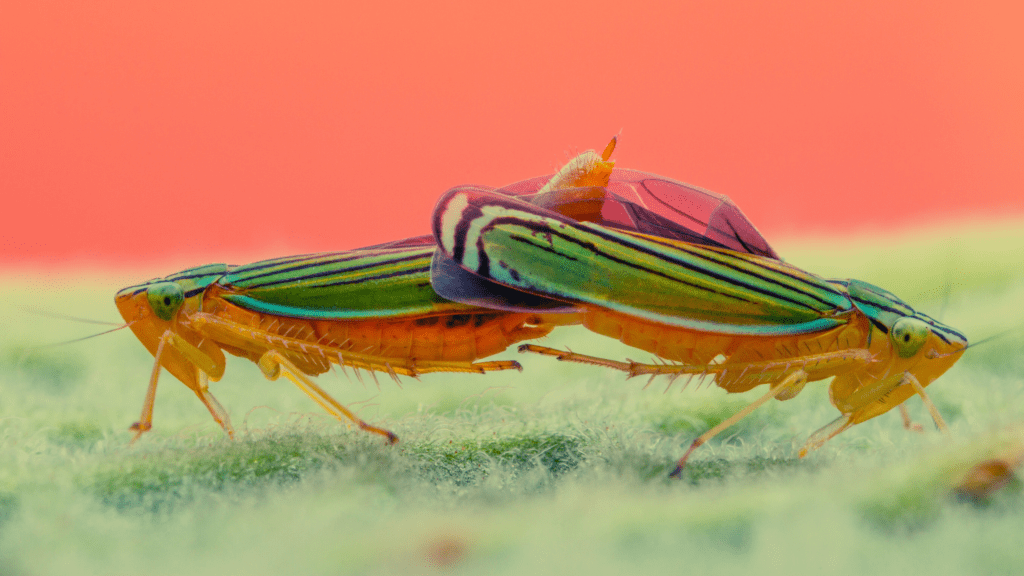
BREAKING: Scientists at Penn State University have successfully replicated the leafhopper’s remarkable ability to vanish into its surroundings, a breakthrough that could revolutionize multiple industries. The research, published in ACS Nano, reveals a method that significantly reduces glare, making surfaces less detectable and opening new avenues for technological advancements.
The study focuses on the leafhopper’s unique use of brochosomes, tiny hollow particles that effectively scatter light. These structures, resembling mini soccer balls, coat the insect’s wings and exoskeleton, reducing reflected glare by an astonishing 80 to 96 percent across both visible and ultraviolet light. This ability helps the leafhopper evade predators that rely on light reflection to spot their prey.
In a groundbreaking laboratory technique, the Penn State team developed a microfluidic system that generates these microscopic particles at an impressive speed of over 100,000 particles per second. By manipulating the polymer chemistry within the droplets, researchers created five distinct designs of brochosomes, each mimicking patterns seen in various leafhopper species.
The implications of this research extend far beyond simple curiosity. The ability to create surfaces that minimize light reflection could enhance the efficiency of energy devices and improve optical materials through better glare control. Moreover, military applications are being discussed, with potential for advanced camouflage technologies, though further testing is needed to translate these findings into practical use.
The study also hints at potential biomedical applications, particularly in drug delivery, leveraging the unique shape and surface properties of the brochosomes. While this area remains unexplored, the possibilities are promising.
What makes this research particularly compelling is its origin: a common backyard insect. The leafhopper’s evolutionary adaptation to manage light has now inspired scientists to replicate this natural phenomenon at scale, a feat that could lead to significant advancements across various fields.
As this story develops, the scientific community and industry leaders will be watching closely for practical applications of this innovative technology. The next steps could change how we approach everything from energy efficiency to military strategy.
Stay tuned for more updates on this exciting breakthrough as researchers continue to explore the potential of nature-inspired innovations.