Scientists have made groundbreaking observations of the Sun, thanks to the Parker Solar Probe. This spacecraft, launched by NASA, recently completed its closest approach to the Sun, capturing unprecedented images of magnetic activity, including massive magnetic “tadpoles.” These structures, which can span tens of thousands of kilometers, were documented in a study published in The Astrophysical Journal Letters by Angelos Vourlidas from Johns Hopkins University’s Applied Physics Laboratory.
On its 22nd perihelion, the Parker Solar Probe flew within approximately 4 million miles of the Sun in December 2024. While this distance may seem vast, it is considered to be within the Sun’s atmosphere. This proximity allowed the probe’s advanced imaging systems to observe magnetic explosions occurring almost directly in front of it.
Revealing Magnetic Tadpoles
The first major finding from the probe’s observations was the confirmation of magnetic “tadpoles.” These dark, elongated shapes were seen moving within magnetic loops, appearing to swim toward the Sun. They are believed to be fragments of a magnetic loop that has “broken,” sending energy back toward the solar surface while ejecting other parts into space. This phenomenon, referred to as “inflow swarms,” had long been theorized, but this mission marked the first time such structures were observed in high resolution. Some of these swarms were small enough that they could not have been detected from Earth; even so, they measured roughly twice the diameter of our planet.
Scientists assert that these inflow swarms are crucial for understanding solar storm activity, prompting plans for ongoing monitoring due to their potential effects on space weather impacting Earth.
Observing the Heliospheric Current Sheet
Another significant observation involved the disturbance of the Heliospheric Current Sheet (HCS), an electrical sheet that divides the Sun’s north and south magnetic fields. The Parker Solar Probe documented an event where part of this structure stretched, shook, and ultimately tore apart, a process known as “tearing-mode instability.” This event was likened to a flag flapping in a storm, demonstrating how a solar storm compressed the sheet until it fractured into separate pieces.
During this event, a particularly large tadpole was recorded expanding at an incredible speed of 5,000 km/minute for over two hours, ultimately growing in size by more than 185 times before disappearing. This observation has provided vital insight into the dynamics of solar magnetic fields.
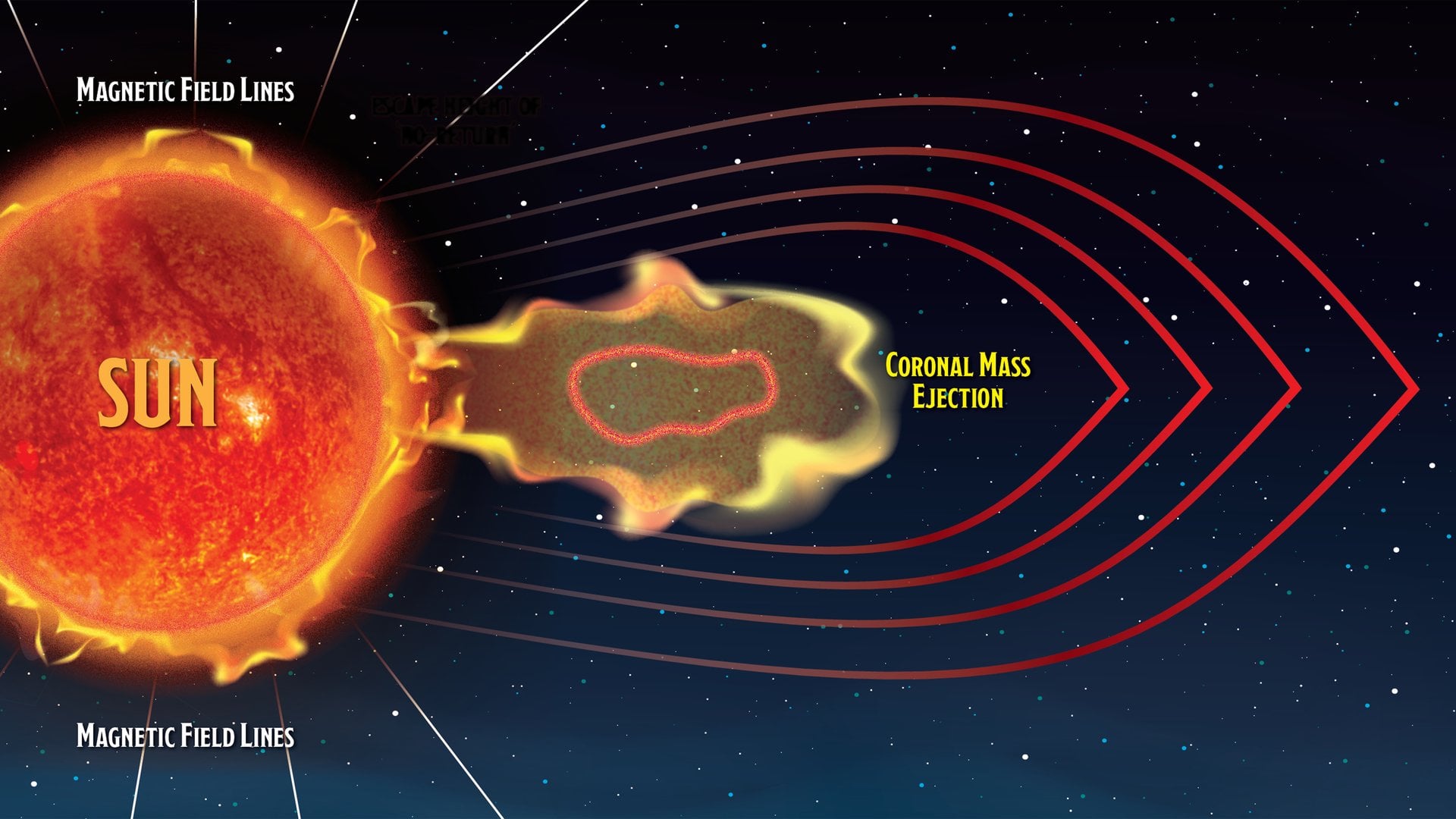
The third major discovery involved watching the “birth” of magnetic pairs. As Parker observed a single magnetic structure in the Sun’s corona being pinched in the middle, it separated into two distinct parts. One segment was drawn back into the Sun, while the other shot away at an astonishing speed of 560 km/s, exceeding previous model predictions. This process, known as “pinch off,” is critical for the formation of solar storms and is believed to be responsible for the release of hazardous particles during coronal mass ejections (CMEs).
The detailed capture of this process marks a significant advancement for heliophysics, as scientists will need to update their models to accommodate the higher speeds observed by the Parker probe.
As the mission continues, the Parker Solar Probe aims to make several more close passes near the Sun, approximately four times a year, until its fuel runs out. This continuous exploration promises to yield even more vivid imagery and data, enhancing our understanding of our closest star. Although the probe’s primary mission concluded in June, its ongoing observations are poised to solidify its legacy as a groundbreaking tool in solar research.
Through these discoveries, humanity’s ingenuity shines brightly, offering a deeper comprehension of the Sun’s complex behavior and its influence on our solar system.