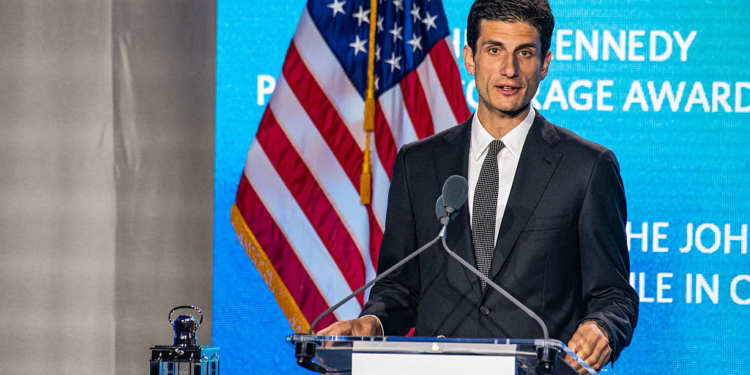
The decision to add President Donald Trump‘s name to the John F. Kennedy Center for the Performing Arts has sparked significant controversy. On December 18, 2025, White House Press Secretary Karoline Leavitt announced that the board had voted unanimously to rename the venue as the “Trump–Kennedy Center.” This statement was met with immediate backlash from board members and public figures, including Jack Schlossberg, the grandson of President John F. Kennedy.
Schlossberg publicly disputed the White House’s assertion of a unanimous vote, claiming that board members were silenced during the meeting. He took to social media platform X to express his concerns, stating, “Microphones were muted and the board meeting and vote NOT unanimous.” Schlossberg, who is currently running for a congressional seat, suggested that the vote may have been influenced by personal motivations linked to his political campaign. He wrote, “I’m told Trump explicitly motivated to act by JACK FOR NEW YORK. Our campaign represents everything Trump can’t stand or defeat.”
Board Members Respond to Allegations
The controversy intensified with statements from Joyce Beatty, a member of the Kennedy Center board and a representative from Ohio. She corroborated Schlossberg’s claims, asserting that she and others were muted during the meeting, preventing them from voicing their opposition to the renaming. Beatty remarked, “For the record. This was not unanimous. I was muted on the call and not allowed to speak or voice my opposition to this move.” She condemned the situation as censorship and emphasized that the renaming was not included in the meeting agenda.
Beatty further expressed her concern over the lack of transparency in the decision-making process. “This center, the Kennedy Center, was created by Congress,” she said. “I think it’s important for us to know that this is just another attempt to evade the law and not let the people have a say.”
The Political Context Surrounding the Renaming
Trump has previously indicated his desire to influence the Kennedy Center’s legacy. In early 2025, he appointed himself chairman, replacing existing board members with individuals aligned with his political agenda. In July of that year, Republican Representative Bob Onder introduced a bill to rename the building the “Donald J. Trump Center for Performing Arts,” though it did not progress through Congress.
Schlossberg has expressed that the proposed renaming violates federal law governing the Kennedy Center’s status as a memorial. He referenced Public Law 88-260, stating, “Plain reading of the statute makes clear — YOU CAN’T DO THAT.” For Schlossberg, the issue is deeply personal; he perceives Trump’s actions as an attempt to overshadow history rather than honor it. He has previously stated, “Trump is obsessed with being bigger than JFK. As if that elevates him. It doesn’t.”
As the situation unfolds, questions remain regarding the legitimacy of the vote and the transparency of the process. The public continues to seek clarity on the events that transpired during the board meeting and whether the voices of dissenting members will be acknowledged. The ongoing discourse surrounding this decision reflects broader tensions regarding political influence in cultural institutions.
The future of the Kennedy Center, along with its renaming, now sits at a complex intersection of politics, culture, and public opinion. As reactions from various stakeholders continue to emerge, it is clear that this issue will not fade quietly into the background.