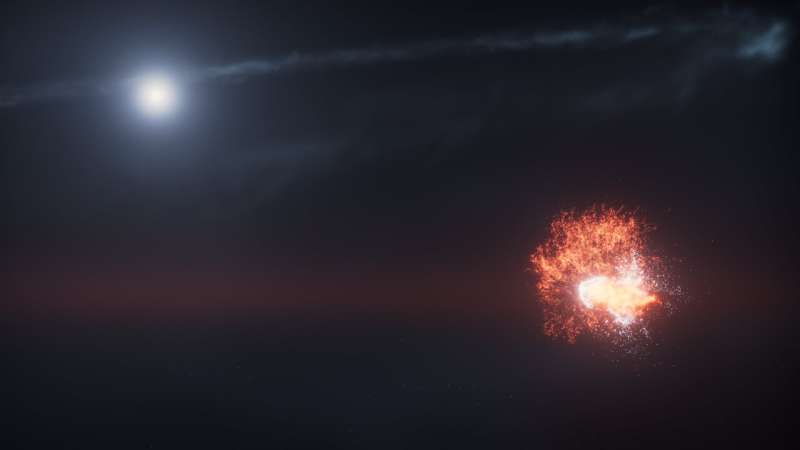
NASA’s Hubble Space Telescope recently captured an extraordinary astronomical event involving two colliding space rocks within the Fomalhaut planetary system, located just 25 light-years from Earth. Initially mistaken for a dust-covered exoplanet, the bright object revealed itself to be the remnants of a rare cosmic collision. This discovery sheds light on the processes of planet formation and the building blocks that make up new worlds.
Unraveling the Mystery of Fomalhaut
A team of international astrophysicists, including Jason Wang from Northwestern University, has confirmed that the luminous clouds observed were not planets but the consequences of two violent collisions among small rocky objects known as planetesimals. “Spotting a new light source in the dust belt around a star was surprising. We did not expect that at all,” Wang stated, underscoring the significance of the findings.
The event marks the first time astronomers have witnessed such collisions outside our solar system. Wang explained that understanding planetesimal collisions is vital not just for insights into how planets form, but also for implications regarding planetary defense initiatives like the Double Asteroid Redirection Test (DART).
Paul Kalas, an astronomer at the University of California, Berkeley and lead author of the study published in the journal Science, remarked, “This is certainly the first time I’ve ever seen a point of light appear out of nowhere in an exoplanetary system.” The discovery’s rarity lies in its timing; astronomers had been monitoring the Fomalhaut system for over two decades, and the light source had not been present in previous images.
The Fomalhaut System’s Unique Characteristics
The Fomalhaut system has long intrigued astronomers due to its massive dust belts and the elusive Fomalhaut b, an exoplanet candidate that has puzzled scientists since its initial observation in 2008. For years, researchers debated whether Fomalhaut b was a genuine planet or merely a large cloud of dust. In 2023, Hubble’s observations confirmed that Fomalhaut b had disappeared, only for a new bright point of light, now designated as Fomalhaut cs2, to appear nearby.
This new light source suggests that both Fomalhaut b and cs2 are likely the result of catastrophic collisions among planetesimals. “The disappearance of Fomalhaut b supports the hypothesis that it was a dissipating dust cloud, likely produced by a collision,” Wang noted. The brightness and positioning of Fomalhaut cs2 closely resemble earlier observations of Fomalhaut cs1, reinforcing the theory that these are not planets but rather the aftermath of cosmic collisions.
The frequency of such collisions has also been called into question. Kalas pointed out that theoretical models suggest a collision should occur roughly once every 100,000 years. Yet, within a mere 20 years, astronomers have documented two significant events in this system. “If you had a movie of the last 3,000 years, sped up so that every year was a fraction of a second, imagine how many flashes you’d see over that time,” he explained.
Wang contributed to validating the findings by conducting independent analyses, which confirmed the detection of these transient events within Fomalhaut’s dust belt. “This is the first time we’re seeing something like this,” he said. “We had to ensure we could trust our images and measure the properties of the collisions accurately.”
While this discovery offers invaluable insights into planetary formation and collisional dynamics, it also serves as a cautionary tale about misinterpreting similar dust clouds as actual planets. Kalas highlighted the importance of distinguishing these transient clouds from genuine exoplanets, especially as upcoming telescopes, including the Giant Magellan Telescope, aim to image habitable-zone planets around nearby stars.
“Fomalhaut cs2 looks exactly like an extrasolar planet reflecting starlight,” Kalas warned. “What we learned from studying cs1 is that a large dust cloud can masquerade as a planet for many years, which is crucial for future missions aiming to detect extrasolar planets in reflected light.”
Although Fomalhaut cs1 has faded from view, the research team remains committed to monitoring the Fomalhaut system. They plan to track the evolution of Fomalhaut cs2 using the Near-Infrared Camera (NIRCam) on NASA’s James Webb Space Telescope (JWST). This advanced instrument will provide color information that Hubble’s capabilities could not, potentially revealing the size and composition of the cloud’s dust grains, including the presence of water and ice.
“Due to Hubble’s age, it can no longer collect reliable data of the system,” Wang stated, expressing optimism about the capabilities of the JWST. “We have an approved JWST program to follow up this planetesimal collision to understand the new circumstellar source and the nature of its two parent planetesimals that collided.”
The findings not only enhance our comprehension of cosmic phenomena but also invite further exploration of the intricate processes that govern the universe. As researchers continue to study the Fomalhaut system, the potential for groundbreaking discoveries remains vast.