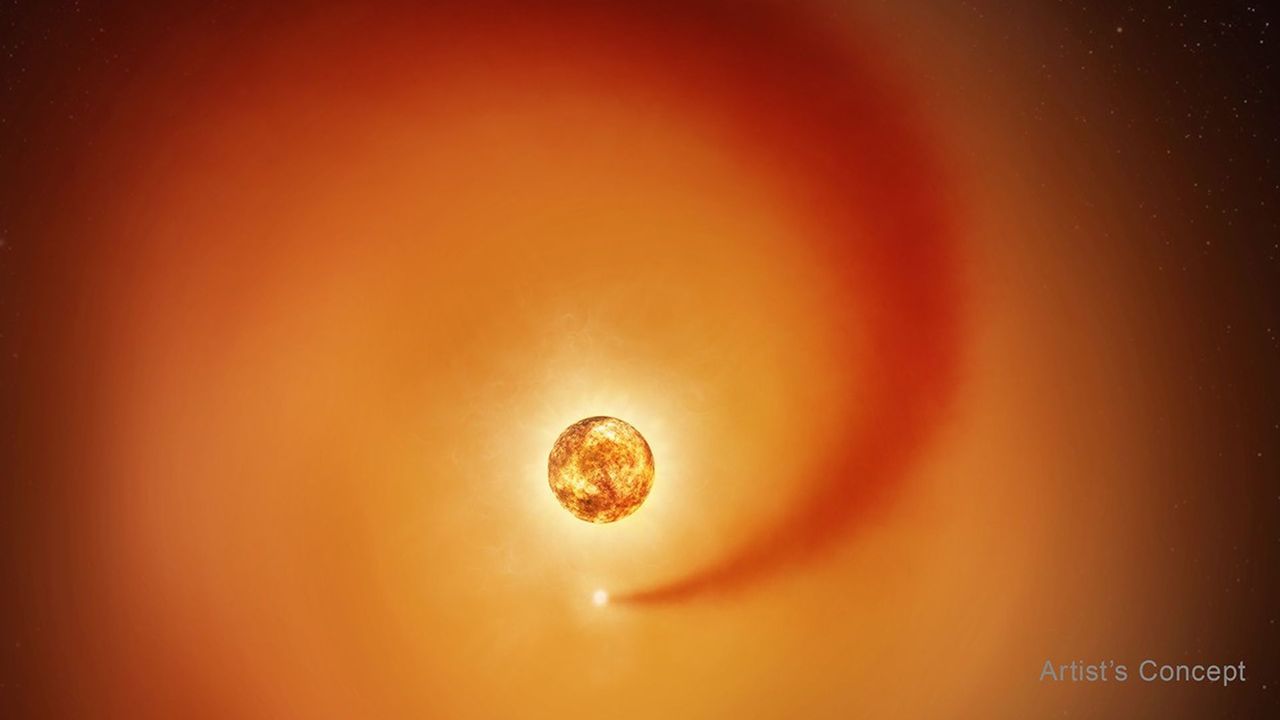
Astronomers have made a groundbreaking observation of a supermassive black hole consuming a nearby star, revealing evidence of a rare phenomenon known as “Lense-Thirring precession.” This effect, which involves a rapidly spinning black hole dragging the fabric of spacetime, was first predicted by Albert Einstein in his 1915 theory of general relativity. The discovery not only confirms a century-old prediction but also enhances our understanding of how black holes interact with their surroundings.
The research centers on a tidal disruption event (TDE) designated AT2020afhd. During a TDE, a star strays too close to a supermassive black hole—potentially weighing billions of times more than the sun—resulting in extreme gravitational forces that stretch and tear the star apart. This process, informally known as “spaghettification,” forms an accretion disk of stellar debris around the black hole. The study, published on December 10, 2023, in the journal Science Advances, highlights how these cosmic phenomena provide a unique opportunity to investigate the mechanics of black holes.
Understanding Lense-Thirring Precession
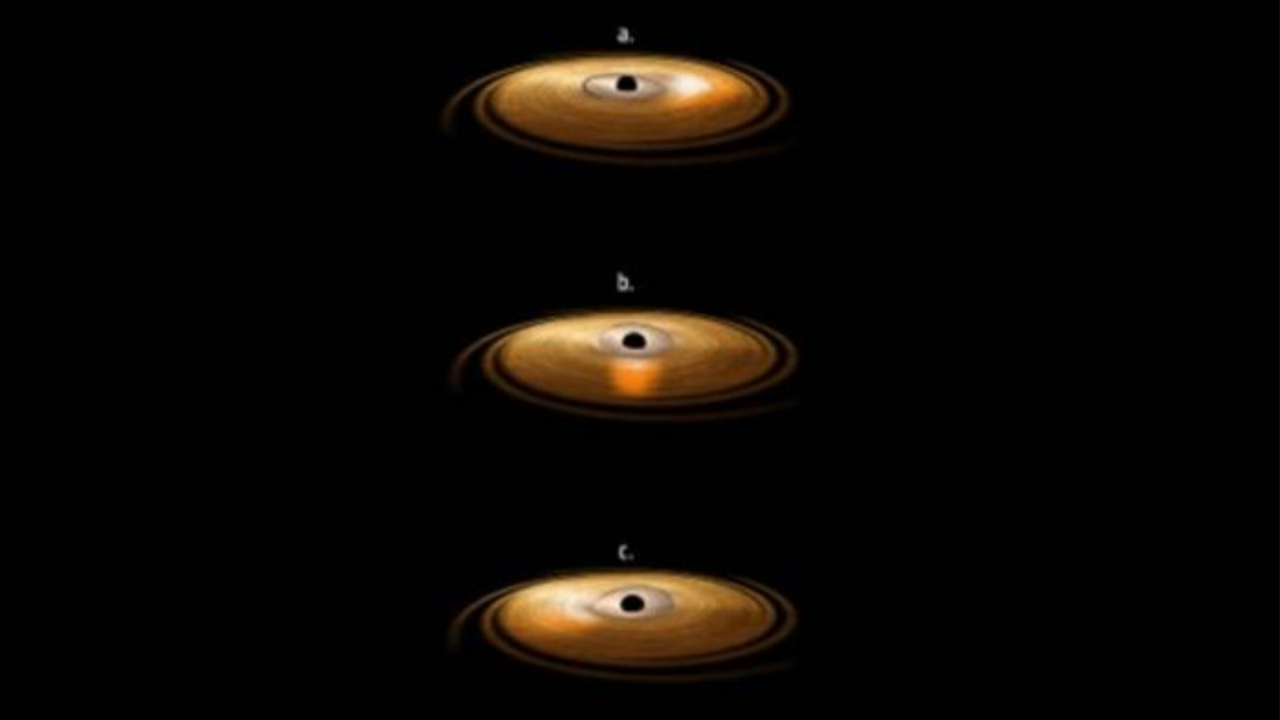
The research team employed data from the Neil Gehrels Swift Observatory and the Karl G. Jansky Very Large Array to observe the TDE. They noted rhythmic variations in both X-ray and radio wave emissions from AT2020afhd, suggesting that the accretion disk and the jets of material ejected from the black hole were wobbling in unison, completing a cycle every 20 Earth days.
Cosimo Inserra, a team member from Cardiff University, explained, “Our study shows the most compelling evidence yet of Lense-Thirring precession—a black hole dragging spacetime along with it in much the same way that a spinning top might drag the water around it in a whirlpool.” This observation offers a fresh perspective on TDEs and how they can produce powerful jets of plasma that shoot out at nearly the speed of light.
The Implications of Frame-Dragging
The discovery of frame-dragging enhances our understanding of how massive rotating objects, such as black holes, influence the motion of nearby stars and cosmic objects. The team’s findings suggest that, similar to how a charged object generates a magnetic field when it rotates, a spinning black hole generates a gravitomagnetic field. This field affects the surrounding spacetime, leading to observable changes in the motion of matter in the accretion disk.
Inserra emphasized the significance of these findings: “By showing that a black hole can drag spacetime and create this frame-dragging effect, we are also beginning to understand the mechanics of the process.” The research not only confirms Einstein’s predictions but also opens up new avenues for studying black holes and their interactions with the universe.
As scientists continue to unravel the mysteries of the cosmos, this research serves as a reminder of the extraordinary phenomena present in our universe. The ability to observe such intricate details reinforces the notion that we are only beginning to scratch the surface of understanding the vast and complex structure of space and time.