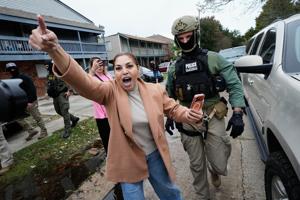
State and federal authorities in New Orleans have intensified their monitoring of online criticism and protests against the recent immigration enforcement operation known as “Catahoula Crunch.” Law enforcement records reviewed by The Associated Press reveal that officials are tracking message boards and social media platforms continuously for potential threats to agents while compiling updates on public sentiment regarding the arrests made as part of this initiative.
The crackdown, which began last week, has drawn scrutiny due to a lack of transparency surrounding the arrests. Local leaders have expressed frustration over being kept in the dark about the details of the operation. “Online opinions still remain mixed, with some supporting the operations while others are against them,” stated a law enforcement briefing issued on Sunday. As the operation unfolded, earlier communications indicated that various groups were urging the public to document actions taken by ICE and Border Patrol agents.
The U.S. Department of Homeland Security (DHS) has asserted that these sweeps are primarily aimed at apprehending “criminal illegal aliens.” However, data from law enforcement records indicate that less than one-third of the 38 individuals arrested in the first two days of the operation had significant criminal histories. Local officials have raised concerns that this undermines the stated objectives of the crackdown.
State Senator Royce Duplessis, who represents New Orleans, criticized the operation, arguing that it perpetuates harmful stereotypes of immigrants. “It confirms what we already knew — this was not about public safety; it’s about stoking chaos and fear and terrorizing communities,” he remarked. Local leaders, including New Orleans City Council President J.P. Morrell, echoed these sentiments, underscoring the disconnect between the operation’s goals and its execution. “There’s literally no information being given to the city of New Orleans whatsoever,” Morrell stated.
Despite assurances from DHS that the operation targets violent offenders, law enforcement records show that only nine of those arrested had criminal histories beyond minor traffic violations. This raises questions about the effectiveness and intent of the operation. The agency has publicly confirmed merely six arrests, including individuals with past convictions for serious crimes such as homicide and sexual assault.
DHS spokesperson Tricia McLaughlin emphasized that the goal is to ensure public safety, asserting, “Americans should be able to live without fear of violent criminal illegal aliens harming them, their families, or their neighbors.” The agency has announced plans to make at least 5,000 arrests in the region over the course of a two-month operation.
The monitoring activities have also attracted criticism for potentially stifling free speech. Authorities have warned that any interference with immigration enforcement could lead to criminal charges, causing apprehension among community organizers. Activist Rachel Taber from Union Migrante stated, “They can monitor me all they want. We are not doing anything illegal.”
In response to growing dissent, Louisiana State Police have pledged to provide operational support to immigration authorities, cautioning the public against actions that could impede federal enforcement efforts. Trooper Danny Berrincha, a state police spokesperson, confirmed that the agency is closely monitoring social media connected to protests and activism.
The operation has also seen collaboration among various agencies, including the FBI and Customs and Border Protection, who are stationed at the Louisiana State Analytical and Fusion Exchange. This center is actively tracking discussions on platforms like Reddit, where local residents share information about the immigration raids. Some online discussions have accused agents of racial profiling, particularly in Hispanic neighborhoods.
As the operation continues, public reaction remains mixed. Many citizens have expressed concern over the emotional impact of the arrests, particularly on families. A briefing noted that videos showing children crying as their parents are taken into custody weigh heavily on the hearts of some supporters of the operation.
The ongoing surveillance extends to tracking tools used by protesters to counteract federal immigration enforcement. Activists have developed resources to document arrests and share information widely among community members. As the situation evolves, local officials and residents continue to seek clarity and transparency regarding the goals and methods of the immigration crackdown in New Orleans.