This week, significant advancements in scientific research have captivated the global community, revealing a wealth of discoveries ranging from ancient human populations to cosmic phenomena. Noteworthy findings include the identification of the largest spinning structure in the universe, the genetic isolation of a human population for 100,000 years, and the unveiling of a massive pit filled with skulls in China.
Cosmic Discoveries and Ancient Populations
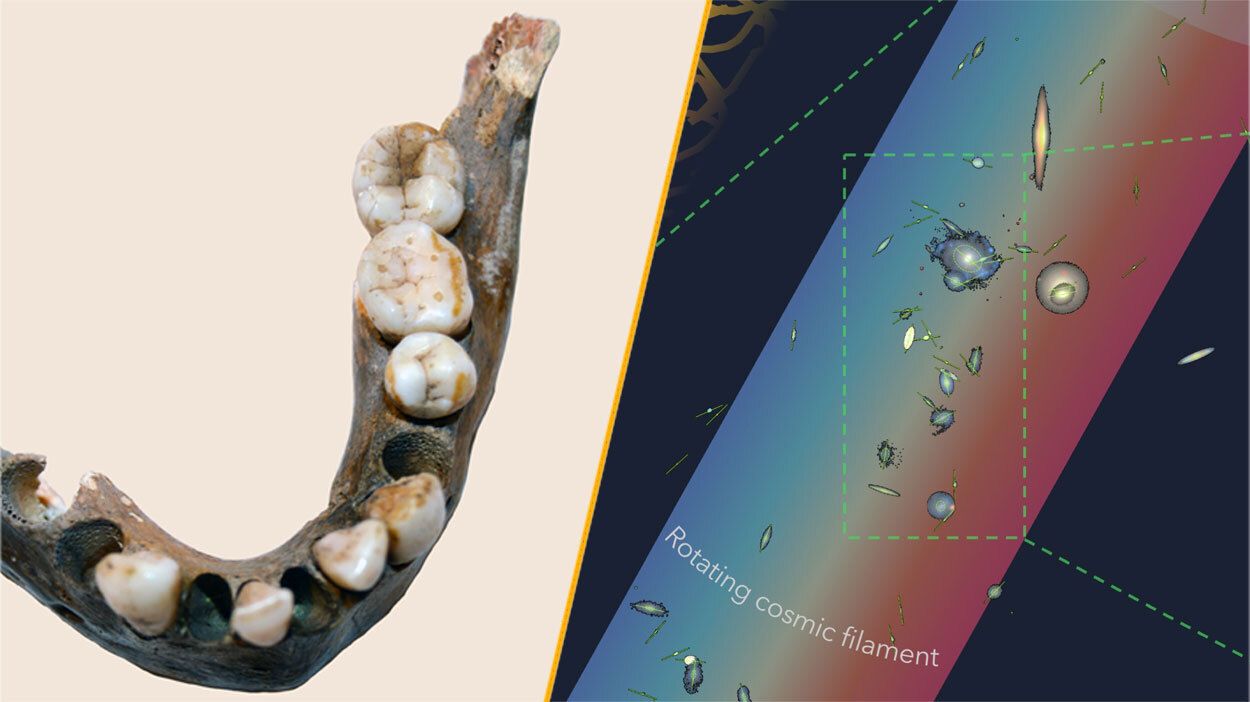
Astronomers have identified an extraordinary rotating filament located approximately 140 million light-years from Earth, marking it as the largest spinning object in the known universe. This colossal structure, wider than the Milky Way, is connected to a chain of 14 galaxies. The filament spins at an astonishing velocity of about 68 miles per second (110 kilometers per second), providing insights into the dynamics of cosmic structures.
In a separate but equally fascinating study, researchers in southern Africa examined human skeletons dating back up to 10,000 years that were discovered south of the Limpopo River. Analysis revealed that these individuals, who lived more than 1,400 years ago, exhibited a drastically different genetic makeup compared to modern humans. The findings suggest they represent “an extreme end of human genetic variation,” underscoring the diversity of human ancestry.
In a striking archaeological discovery, a massive pit filled with skulls was uncovered near a 4,000-year-old city in China. What is particularly puzzling for archaeologists is that nearly all the skulls belong to males, which diverges significantly from typical sacrificial patterns observed in similar settlements.
Environmental Changes and Modern Innovations
In modern news, an ambitious ecosystem engineering project initiated decades ago in China has produced unforeseen consequences. The Great Green Wall project aimed to combat desertification through extensive tree planting. While the project has been successful in halting advancing deserts, a new analysis indicates it has inadvertently altered rainfall and evaporation patterns, resulting in lower water levels in some of China’s most populous regions.
Additionally, research suggests that the world’s hottest temperature record, set in Death Valley in 1913, may stem from human error. This revelation raises questions about historical climate data accuracy. Furthermore, the potential collapse of a crucial Atlantic current could usher in centuries of drought across Europe, highlighting the interconnectedness of global climatic systems.
On a more positive note, engineers at MIT have developed a groundbreaking method to extract drinking water from the atmosphere using ultrasound technology. This innovative technique can generate water rapidly, even in arid regions, and is reported to be 45 times more efficient than traditional evaporation methods. The team is exploring options to pair the device with solar cells for sustainable energy use.
In the realm of space exploration, interstellar comet 3I/ATLAS has garnered attention for its unique characteristics. Recent observations from the Joan Oró Telescope in northeastern Spain reveal that the comet exhibits spiral jets, suggesting the presence of “ice volcanoes.” This discovery indicates that the comet is undergoing rapid changes as it approaches the sun, similar to other icy celestial bodies in our solar system.
Amidst these significant scientific breakthroughs, researchers unearthed over 18,000 dinosaur tracks in Bolivia’s Carreras Pampa, establishing it as a premier site for dinosaur footprints. This remarkable find spans an area of 80,570 square feet (7,485 square meters), providing valuable insights into prehistoric life.
These discoveries not only enhance our understanding of the universe and our planet but also raise important questions about the human experience and our relationship with the environment. As scientists continue to unravel the mysteries of the cosmos and our own history, the implications of their findings will undoubtedly shape future research and exploration.